


In the Egyptian market, two businesses can sell the same product at similar quality levels, yet one consistently attracts customers at first glance while the other gets overlooked. In most cases, the difference isn’t in the product itself. It’s in how that product is presented. And at the front of that presentation is the sticker.
A sticker isn’t just a label. It’s a core element of the product experience, one that directly influences customer trust, information clarity, and the overall impression of your brand.
Understanding sticker printing prices shouldn’t be about finding the cheapest option. It should be about getting the best value for what you spend.
At Dar Medhat El Sewedy Printing, with over 27 years of experience producing millions of stickers for manufacturers and brands across Egypt and the Middle East, this guide covers everything you need to know about sticker printing prices in Egypt in 2026, practically and clearly.
You’ll find the factors that determine real cost, the differences between material types, and how to choose the right specifications for your product and budget.
The goal isn’t just to present prices, it’s to help you make the right decision from the start.
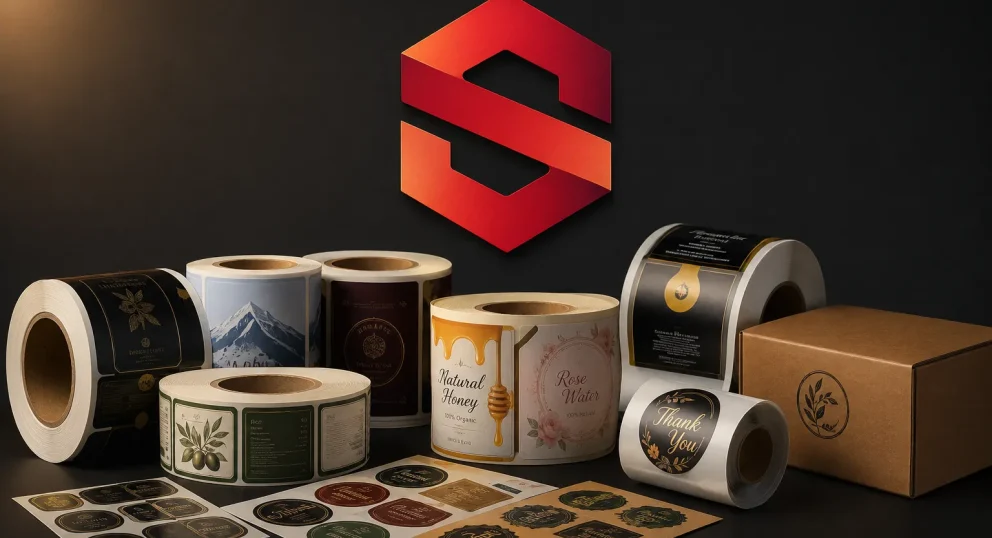
Sticker Types and What Each One Does
Before discussing prices, you need to understand the types, because the wrong material means a sticker that peels within weeks or deteriorates at the first sign of moisture.
1. Paper Sticker
The most widely used and most affordable option. Available in gloss or matte finish, suited for dry indoor applications.
Advantages: lowest cost available; accepts vibrant colour printing; suitable for large quantities on limited budgets.
Limitations: doesn’t withstand moisture or oils; deteriorates quickly in humid environments; not suitable for refrigerated food products.
Best for: indoor identification labels, dry promotional gifts, books and printed materials, temporary promotional stickers.
2. Transparent / Clear Sticker
Creates a premium look as though the design was printed directly onto the packaging, with no white background obscuring the contents of a glass or transparent plastic container.
Polypropylene (PP) material offers good resistance to water, oils, and moderate heat, ideal for personal care products and beverages.
Important note: transparent stickers require a white ink underlay for light-coloured elements. Without it, designs disappear when placed on dark packaging. At Dar Medhat El Sewedy, this is handled automatically on every order.
Best for: perfume bottles, skincare products, glass beverages, any transparent packaging where showing the contents matters.
3. Waterproof Vinyl Sticker
The most durable material in the sticker world. Flexible plastic vinyl that withstands water, oils, sunlight, and scratches, staying intact for years.
Best for: refrigerated products and cold drinks, car and motorcycle stickers, outdoor applications, computers and industrial equipment.
4. Kraft Paper Sticker
A natural brown stock that communicates authenticity and sustainability before a single word is read. Its rough, warm texture creates an immediate sense of craft and credibility.
Best for: specialty coffee, organic and natural products, artisan confectionery, any brand that wants a warm, authentic character.
5. Gold and Silver Foil Sticker
A shiny metallic surface that immediately elevates the perceived value of a product. Gold for warm luxury, silver for modernity and technology.
Best for: perfumes and premium gifts, high-end cosmetics, celebratory and seasonal stickers.
6. Double-Sided Sticker
Adhesive on both sides, used for mounting advertisements on glass from the inside to be read from the outside, or in specific installation applications.
Best for: shop window fronts, window displays, specialised commercial applications.
7. Barcode and QR Code Sticker
Precise printing of barcodes and QR codes to exact technical standards. A code that fails to scan means a problem in distribution and sales.
Best for: inventory management, point of sale, food and pharmaceutical products, e-commerce.
8. Roll Stickers
Stickers wound on a reel for automated application on production lines, faster and more cost-effective for large volumes.
Best for: factories and production lines, businesses that need fast automated application, any quantity exceeding 10,000 pieces.
9. Removable Sticker
A weaker adhesive that allows the sticker to be removed cleanly without leaving residue or tearing the surface.
Best for: price labels, temporary promotional materials, seasonal window displays.
Sticker Printing Prices in Egypt 2026: Indicative Price Tables
Note: The following prices are indicative and subject to raw material costs and exchange rate fluctuations. Contact us directly for an exact quote on your order.
Gloss or Matte Paper Sticker
| Quantity | 5×5 cm | 7×5 cm | 10×7 cm |
| 500 pcs | 350–500 EGP | 450–600 EGP | 600–800 EGP |
| 1,000 pcs | 550–750 EGP | 700–900 EGP | 900–1,200 EGP |
| 5,000 pcs | 1,800–2,500 EGP | 2,200–3,000 EGP | 3,000–4,000 EGP |
| 10,000 pcs | 3,000–4,000 EGP | 3,800–5,000 EGP | 5,000–7,000 EGP |
Transparent (PP / Clear) Sticker
| Quantity | 5×5 cm | 7×4 cm | 10×7 cm |
| 500 pcs | 500–700 EGP | 600–800 EGP | 800–1,100 EGP |
| 1,000 pcs | 800–1,100 EGP | 1,000–1,400 EGP | 1,300–1,800 EGP |
| 5,000 pcs | 2,800–3,800 EGP | 3,500–4,500 EGP | 4,500–6,000 EGP |
Waterproof Vinyl Sticker
| Quantity | 5×5 cm | 10×8 cm | 15×10 cm |
| 500 pcs | 700–1,000 EGP | 1,000–1,400 EGP | 1,500–2,000 EGP |
| 1,000 pcs | 1,200–1,600 EGP | 1,800–2,400 EGP | 2,500–3,500 EGP |
| 5,000 pcs | 4,000–5,500 EGP | 6,000–8,000 EGP | 8,000–11,000 EGP |
Roll Stickers: Estimated per 1,000 metres
| Material | 5 cm width | 10 cm width | 15 cm width |
| Paper | 800–1,200 EGP | 1,400–2,000 EGP | 2,000–2,800 EGP |
| Transparent PP | 1,200–1,800 EGP | 2,000–2,800 EGP | 2,800–4,000 EGP |
| Vinyl | 1,800–2,500 EGP | 3,000–4,200 EGP | 4,200–6,000 EGP |
Factors That Affect Sticker Printing Cost
Sticker printing prices in Egypt aren’t set by a fixed number, they’re the result of several factors working together. Understanding these factors is the difference between a smart order that saves you money and a random one that doubles your budget for no reason.
1. Quantity: The Golden Rule
The higher the quantity, the lower the unit cost, significantly. Setup and preparation costs are fixed; spreading them across 10,000 pieces is a completely different calculation from spreading them across 500.
Practical example for a 5×5 cm paper sticker:
- 500 pieces: unit cost can reach 1 EGP
- 5,000 pieces: unit cost can drop to 0.4 EGP
- 50,000 pieces: unit cost can reach 0.2 EGP
Al Sewedy tip: If you’ll be printing the same sticker more than once during the year, calculate the total cost of printing the full quantity in one run versus multiple smaller runs. The difference is always significant.
2. Material Type
Vinyl costs more than transparent, and transparent costs more than paper, but the cost difference doesn’t compare to the difference in durability and appearance.
A paper sticker on a refrigerated food product peels within weeks. Vinyl lasts years. When calculated correctly, vinyl is always the more cost-effective choice for applications that demand it.
The key rule: the wrong material means reprinting, which means double the cost.
3. Size and Dimensions
A direct relationship: larger size means higher cost. The more efficiently a design can be arranged on the sheet during printing, the less waste, and the lower the price.
Choosing a standard size, such as 5×5 or 7×4 cm, helps reduce offcuts during cutting.
4. Cut Type
The shape of the sticker plays a role in pricing:
- Standard rectangular or circular cut: the fastest and most cost-effective, no additional tooling required.
- Die-Cut (custom shape): enables any shape you want, circular, oval, shaped like your logo, but requires a custom cutting tool added to the cost of the first order only.
- Kiss Cut: cuts through the sticker without cutting the backing paper. The sticker peels off easily and stays on the sheet until it’s needed.
5. Finishing
- Gloss lamination: reflects light and makes colours appear more vivid and vibrant.
- Matte lamination: non-reflective, smooth feel, quiet premium appearance. The most widely used finish in high-end cosmetics.
- Soft Touch: velvety texture that adds a sensory dimension, makes the sticker genuinely memorable.
- Spot UV: targeted gloss on the logo or specific elements, an attractive visual contrast at a reasonable cost.
Every finish adds value and adds cost. Choose what suits your product identity and budget.
6. Colours and Printing Method
In digital printing, the number of colours doesn’t significantly affect price, full CMYK is printed at the same base cost. In offset printing for large volumes, or when custom Pantone colours are specified, cost can increase based on the number of colours required.
7. Delivery Time
Standard delivery (3–7 days): standard pricing. Rush delivery (24–48 hours): additional fees depending on quantity and specifications.
Al Sewedy tip: Planning ahead eliminates rush fees. In printing, urgency always has a price.
Design Tips for Professional Stickers Before Printing
Good design prevents losing an entire production run. These specifications aren’t technical details for their own sake, they’re the difference between a sticker that looks exactly as you imagined and one that disappoints.
Resolution and Dimensions
- 300 DPI minimum: an image that looks sharp on your screen may print blurry if it’s only 72 DPI. Don’t use images taken directly from websites.
- Bleed: leave 3mm outside the actual sticker boundary to avoid white edges after cutting.
- Safe Zone: leave 3mm inside the sticker boundary, no text or important elements outside this zone.
Colour System
- CMYK, not RGB: what you see on screen (RGB) differs from what comes off the press (CMYK). Convert your file to CMYK before sending.
- Pantone colours: if your brand colour is critical, specify the Pantone code to guarantee an exact match.
Common Design Mistakes
- Using a logo downloaded from a website at 72 DPI, results in a blurry logo that damages the product’s appearance.
- Ignoring the bleed, white edges appear on the sticker after cutting, immediately unprofessional.
- Very small text, anything below 6pt is difficult to read, especially on small stickers.
- RGB colours print completely differently, particularly saturated and vibrant tones.
- Not specifying white ink for transparent stickers, light designs disappear on dark packaging.
Gloss vs. Matte: Which Is Right for Your Product?
Gloss reflects light and makes colours appear more vivid and energetic. Ideal for products that rely on food photography or colour as a primary selling tool. Common in food, beverages, and general consumer goods.
Matte is non-reflective, a smooth feel and quiet, refined appearance. Communicates quality and professionalism. The dominant choice for premium cosmetics, perfumes, and products targeting higher-end segments.
Al Sewedy tip: If your product is premium, go matte. If it’s a general consumer product, gloss makes colours pop and draws the eye. If you’re not sure, request a sample of both and decide with your eyes.
How to Order Sticker Printing from Dar Medhat El Sewedy
The ordering process is straightforward:
Step 1: Send your order details, size, quantity, material type, and design.
Step 2: Our team reviews the order and sends you a detailed quote within hours.
Step 3: Once you approve, we send a digital Soft Proof for final review before printing begins.
Step 4: After your sign-off, printing starts immediately and your order is delivered on the agreed date.
Frequently Asked Questions
Does transparent sticker material withstand water and heat?
Yes, if it’s PP or vinyl, both offer good resistance to water, oils, and moderate heat. For high heat or strong chemicals, vinyl is the stronger choice.
What’s the difference between Kiss Cut and Die Cut?
Kiss Cut cuts through the sticker only, leaving the backing paper intact, the sticker peels off easily when needed. Die Cut cuts through both the sticker and the backing paper in the same shape, giving a more finished, professional appearance.
Is there a discount for large quantities?
Yes, significantly. At 10,000 pieces, the unit cost can drop to half or less compared to 500 pieces.
What’s the best sticker type for cosmetic packaging?
Transparent PP or white vinyl with a matte finish, moisture and oil resistant with a premium look that suits cosmetics.
How is roll sticker pricing calculated?
Based on total metres, roll width, material type, number of colours, and finishes. Buying by the roll is always more cost-effective for large volumes.
What’s the difference between removable and permanent stickers?
Permanent stickers have a strong adhesive, difficult to remove without leaving residue. Removable stickers use a weaker adhesive that peels off cleanly without any trace.
What’s the minimum order quantity?
We start from 50 pieces with digital printing. For rolls and economical quantities, the recommended minimum is 1,000 pieces.
Conclusion: The Right Decision Shows Up in Your Sales
Sticker printing prices in Egypt aren’t just numbers to compare. They’re the direct result of decisions made before printing. The choice of material, size, quantity, and finish doesn’t only affect cost, it determines how a customer perceives your product at first glance, whether they trust it and buy it, or walk past it entirely.
A professional sticker doesn’t just add visual appeal. It communicates clearly that your product is well-made and that you care about the details, and it holds up under real-world conditions without losing its appearance or legibility.
A poor-quality sticker, on the other hand, can actively damage how a product is perceived regardless of its actual quality, ultimately translating into lost sales.
The right decision isn’t searching for “the cheapest price”, it’s choosing the solution that delivers the best value for what you spend, and that genuinely serves your product and market.
Why Choose Dar Medhat El Sewedy Printing?
We don’t just provide a printing service, we work as a partner to help you make the right decision from the start:
27+ years of operational experience: across sectors including food, cosmetics, industrial, and commercial.
Recommendations based on actual use: we recommend the right material for your product’s environment (humidity, heat, friction), not what’s most profitable for us.
Real balance between price and quality: we help you find the solution that delivers the best result for your budget, without overpaying or compromising on standards.
Technical review before printing: we check your file to confirm colour accuracy, design clarity, and to catch any cutting or printing issues before they reach the press.
Consistent quality and delivery commitments: professional execution from the first run, with no surprises and no reprints.
If you want a sticker that reflects the quality of your product and delivers the best return on your investment, the next step is simple: send us your project details, and we’ll help you choose the right material and specifications, and execute your order professionally, first time, every time.