


Your product’s packaging is the first thing a customer sees
Premium packaging paper printing has become a core part of how a product is presented and marketed, not just a finishing step after manufacturing. In many cases, a customer forms their first impression of a product’s quality from the packaging before seeing what’s inside.
An ordinary product can appear more valuable with professional packaging, while an excellent product can lose much of its impact if how it’s presented doesn’t reflect its actual quality.
The challenge is that choosing packaging paper isn’t just about appearance. The material type, printing technique, finish, and even the paper’s texture all directly affect the final impression, the user experience, and the packaging’s ability to withstand shipping, storage, and daily handling.
A wrong choice in any of these elements can make packaging look weak regardless of how good the design is.
In a competitive market, packaging is no longer just a means of protecting the product. It has become a complete marketing tool that influences the purchase decision, reinforces brand identity, and creates an unboxing experience that makes customers remember the brand and trust it more.
At Al Sweidy Printing, we work with brands and companies across various sectors that need packaging solutions that genuinely reflect their product quality, not just packaging that serves a protective function.
This guide covers the types of packaging paper, the differences between materials, techniques, and finishes, and how to choose the right solution based on your product and budget.
Why Printed Packaging Paper Is a Priceless Marketing Tool
In a market crowded with products and brands, a product has only a few seconds to capture a customer’s attention before a purchase decision is made. During those moments, packaging plays the biggest role in forming the first impression.
Professional packaging doesn’t just make a product look better. It gives the customer an immediate sense of the quality of what’s inside. The reverse is also true: poor packaging can diminish the value of an excellent product regardless of its actual quality.
That’s why packaging is no longer just a protective element. It has become a core part of how the product itself is sold.
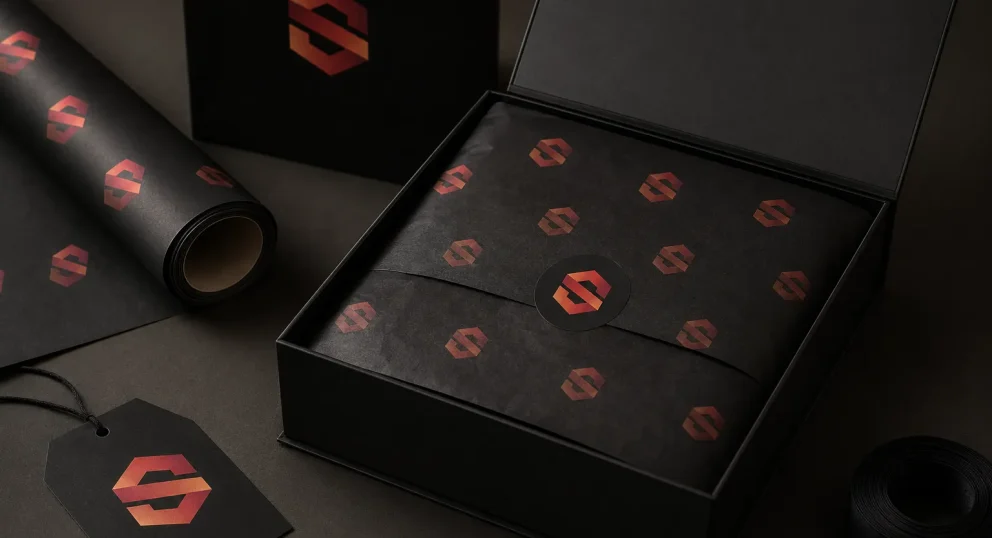
The Unboxing Moment: An Unforgettable Experience
The unboxing experience has become part of modern marketing, especially with the explosion of product unboxing content on YouTube, Instagram, and TikTok generating billions of views.
The customer no longer just buys the product. They buy the feeling connected to receiving it, opening it, and using it for the first time.
When packaging paper is designed and printed professionally, it creates a distinctive moment that leaves a stronger impression on the customer and increases the likelihood they’ll share the experience on social media.
This gives the brand reach and trust that traditional advertising alone struggles to achieve.
Packaging Raises the Perceived Value of a Product
Packaging is the physical reflection of a brand’s personality. Through it, the customer immediately understands the nature of the product. Is it luxurious? Practical? Modern? Eco-friendly? Every detail in the packaging sends a direct message, from the paper type to the texture of the final finish.
The same product is often sold at two different prices simply because of how it’s presented. Luxury packaging raises the perceived value of a product, justifies a higher price, builds greater trust, and turns the customer from a one-time buyer into someone who remembers the brand and associates it with quality and professionalism.
Types of Packaging Paper and the Characteristics of Each
Choosing a packaging paper material is not a cosmetic decision. It’s a fundamental step that determines the final product’s appearance, its durability, and the impression it leaves on the customer.
Each paper type has different characteristics in terms of texture, strength, print quality, and cost, so there is no single “best type” in absolute terms. There is only the most suitable type based on the nature of the product and how it will be used.
The common mistake is choosing the material based on appearance alone, while the right decision must balance the final look, the nature of use, storage and shipping conditions, budget, and the image the brand wants to communicate to the customer.
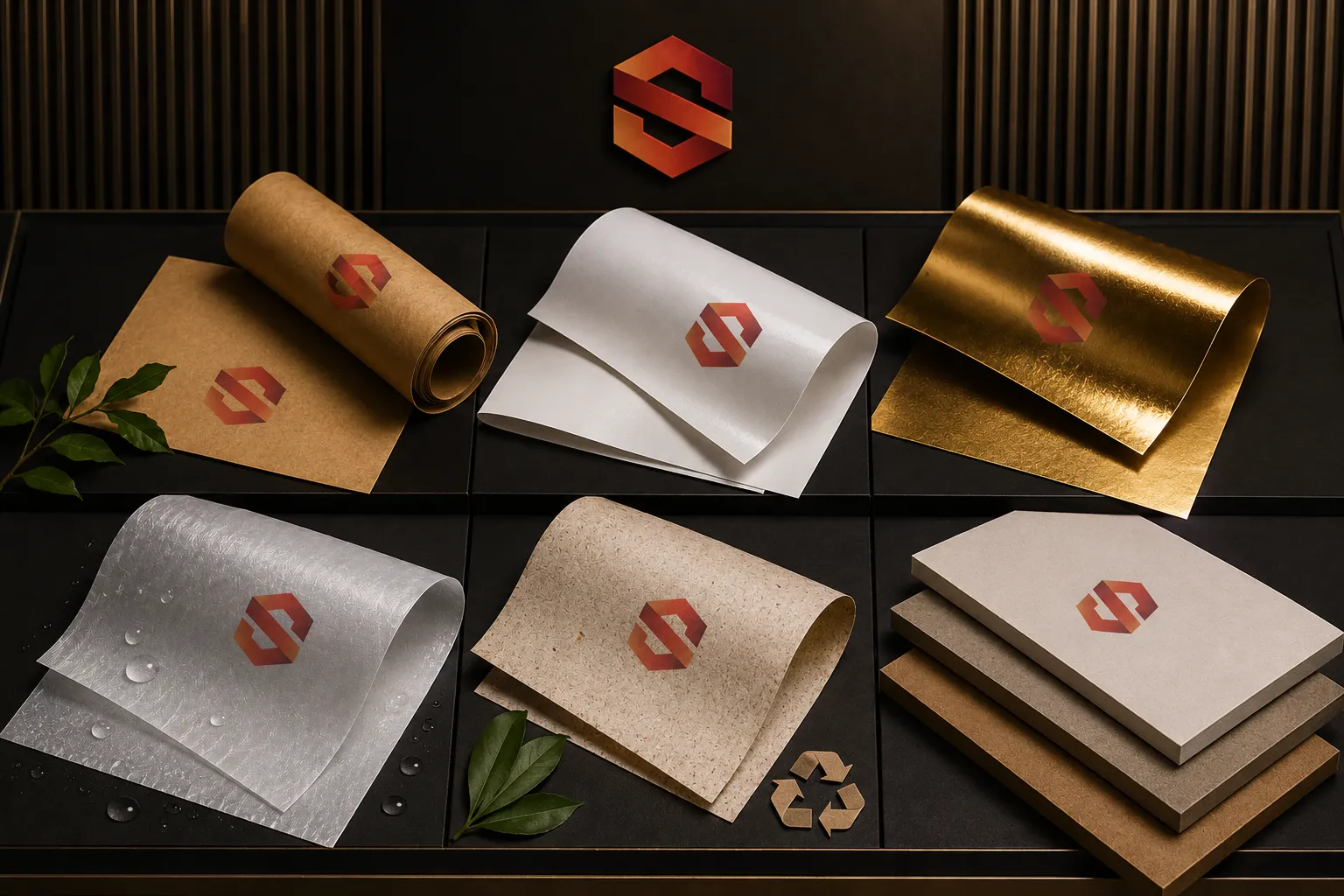
1. Kraft Paper
Kraft paper is one of the most widely used packaging paper types in recent years, especially for brands focused on a natural or sustainable identity. It’s distinguished by its brown or white color and its raw texture, which gives a practical feel closer to handmade and organic products.
Advantages: strong and durable, biodegradable and recyclable, suitable for limited-color printing, gives a warm and authentic character.
Types of kraft paper:
- Natural brown kraft: the most expressive of environmental and artisanal identity. It limits colorful printing but adds a personality no other material can match.
- White kraft: the same strength as brown kraft but with a white surface that allows clearer and more vibrant color printing.
Best for: natural food products, specialty coffee, artisan confectionery, eco-friendly brands, e-commerce gifts.
2. Coated Paper (Coated/Glossy)
Coated paper is the most widely used choice when high-quality printing with strong colors and fine detail is needed.
It comes with a polished surface, either glossy or matte, making it ideal for packaging that relies on images and strong visual designs.
Advantages: exceptional print quality, vivid and vibrant colors, smooth surface that reflects luxury, available in weights from 90 to 350 gsm.
Glossy vs. Matte:
- Glossy: reflects light and makes colors appear more vibrant. Ideal for food and consumer products.
- Matte: calm and refined, doesn’t reflect light and gives a smooth texture. The first choice for luxury products.
Best for: electronics, cosmetics, gifts, packaged food, any product that relies on images as a selling tool.
3. Foil Paper (Metallic Foil)
Foil paper adds an immediate sense of luxury through its metallic surface, whether in gold, silver, or other metallic colors.
It’s often used as a finishing element to highlight a logo or specific details, but it can also be used as full packaging material for very luxury products.
Advantages: unmatched visual luxury, immediate visual impact on the shelf, suitable for thermal transfer printing.
Best for: premium chocolate and confectionery, perfumes, seasonal gifts, any product targeting the top market segment.
4. Synthetic Paper
Made from polymeric materials, it looks and prints like paper but behaves like plastic. Fully resistant to water, moisture, and oils.
Best for: refrigerated food products, personal care products, external packaging exposed to humidity.
5. Eco-Friendly Packaging Paper
Recycled paper or paper made from alternative plant fibers, printed with plant-based eco-friendly inks such as soy inks. For brands that make sustainability part of their identity.
Best for: eco-friendly brands, organic products, companies committed to social responsibility.
6. Cardboard/Board
For rigid packaging that both protects the product and presents it. Includes duplex, white cardboard, and heavy-duty cardboard in various weights.
Best for: formed boxes, rigid gift packaging, electronics products, any product requiring structural protection.
Packaging Paper Comparison Table
| Type | Print Quality | Durability | Character | Best For |
| Brown Kraft | Good | High | Natural and eco | Organic and artisan |
| White Kraft | Very good | High | Clean and authentic | Gifts and e-commerce |
| Glossy Coated | Excellent | Medium | Vibrant and bright | Food and electronics |
| Matte Coated | Excellent | Medium | Calm and refined | Luxury and beauty |
| Metallic Foil | Good | Medium | Exceptional luxury | Gifts and luxury chocolate |
| Synthetic | Very good | Very high | Modern and durable | Humidity and cold environments |
| Recycled Eco | Good | Medium | Responsible and authentic | Eco-friendly brands |
The Difference Between Food Packaging and Luxury Packaging
There is a significant difference between packaging designed for food products and packaging designed for luxury products, because each type has completely different requirements.
Food Packaging focuses on food safety (Food Grade), resistance to moisture and oils, preserving product quality, and using safe inks that don’t interact with food.
Specific materials and printing techniques are chosen to ensure product safety during storage, transport, and use.
Luxury Packaging focuses more on visual appearance, texture, the unboxing experience, and special finishes such as foil stamping, Spot UV, and embossing.
The goal isn’t protection alone, but creating an experience that reflects the brand’s value and justifies a higher product price.
An important point before choosing the material: the right material isn’t always the most expensive one. It’s the one that achieves the right balance between appearance quality, durability, production cost, and the actual use of the product.
How to Choose the Right Printing Technique for Packaging Paper
After selecting the right material, the printing stage follows. This is where the design transforms from a file on a screen into real packaging that reflects the brand’s quality. The decision here isn’t just about appearance.
It involves important factors like required quantity, color accuracy, turnaround time, and final cost.
1. Offset Printing on Packaging Paper
Offset printing is the most professional and economical choice for producing large quantities of packaging paper.
This technique uses printing plates that deliver high color accuracy and excellent consistency across all printed copies, making it ideal for brands that need visual identity uniformity across thousands of pieces.
The larger the quantity, the more economical offset becomes per unit, which is why it’s widely used in factories, large production lines, and large-scale commercial packaging operations.
Advantages: unmatched photographic image quality, per-copy cost decreases with quantity, absolute Pantone color accuracy, suitable for various paper weights.
Best for quantities: 500 pieces and above. Best for brands that need consistent visual identity across thousands of pieces, factories, and widely distributed consumer products.
Expert insight: your logo color defined by a specific Pantone code? Offset prints it with 100% consistency in every piece and every batch, regardless of quantity. That is what real visual identity consistency means.
2. Digital Printing
When quantities are limited or fast turnaround is needed, digital printing becomes the most suitable solution.
This technique doesn’t require complex setup like offset, allowing orders to be fulfilled with greater speed and flexibility. It’s heavily used for seasonal promotions, limited editions, startups, and testing a new design before large-scale production.
Advantages: suitable for quantities from 50 to 500 pieces, complete flexibility to change designs, much shorter delivery time, ideal for limited and seasonal editions.
Best for: startups, seasonal promotions, limited editions, testing a new design before large-scale production.
3. Flexo Printing on Packaging Paper
The fastest and most economical option for very large quantities. Uses flexible plates and operates at high production speeds.
Best for: large factories needing millions of units, simple external packaging, large packaging bags.
Available Finishes for Packaging Paper
The finish is the stage that gives packaging paper its final look and feel. In many cases, the difference between standard packaging and premium packaging isn’t just in the design. It’s in the type of finish used.
1. Lamination
A transparent plastic layer added over the print that protects against scratches and moisture and elevates the packaging’s appearance.
- Matte: calm and refined, smooth texture that suggests luxury. The first choice for cosmetics and premium products.
- Glossy: makes colors stand out and appear more vibrant. Ideal for food and consumer products.
- Soft Touch: a velvety texture that adds a sensory dimension. Customers pick it up and immediately want to touch it again.
2. Spot UV
A glossy lacquer layer applied only to specific areas: the logo, product name, or any element you want to highlight. It creates a visual and tactile contrast that draws the eye immediately.
Expert insight: matte as a background with Spot UV on the logo is the combination we’ve been asked for more than any other finish in the factory’s history. Simplicity and distinction at the same time.
3. Hot Stamping
Real metallic foils, gold, silver, or copper, applied with heat and pressure. A metallic shine that no ink can replicate. For luxury packaging that wants to say “this is an exceptional product” from the very first touch.
4. Embossing and Debossing
This finish adds a tactile dimension to packaging by raising some elements or pressing them into the paper, such as the logo or name. The result isn’t just seen. It’s felt with touch, which gives packaging a more professional and distinctive value.
Embossing: the logo or any element rises above the packaging surface, a tangible relief that adds a third dimension.
Debossing: the element is gently pressed inward, quiet elegance felt with a touch.
5. Water-Based Varnish
A transparent, food-safe protective layer added over the print to protect colors from oils and moisture without adding noticeable thickness. The most suitable choice for food packaging.
Finishes Comparison Table
| Finish | Visual Effect | Tactile Effect | Best For |
| Matte Lamination | Calm and refined | Smooth | Luxury and beauty |
| Glossy Lamination | Vibrant and bright | Smooth and shiny | Food and beverages |
| Soft Touch | Refined and distinctive | Velvety | Ultra-luxury |
| Spot UV | Visual contrast | Locally glossy | Logos and headlines |
| Hot Stamping | Exceptional luxury | Metallic | Gifts and luxury |
| Embossing | Raised and dimensional | Tangible relief | Luxury logos |
| Water-Based Varnish | Natural and transparent | Light | Food-safe applications |
Sectors Served by Al Sweidy in Packaging Paper Printing
Food Product Packaging
The most complex in terms of requirements, combining beauty and safety.
Food packaging requires Food Grade approved materials (not all cardboard or paper is safe for food contact), safe inks free of heavy metals and harmful substances that comply with food safety authority standards, safe finishes such as water-based varnish or food-approved lamination, and attractive colors since dish photography sells and good printing on food packaging directly increases sales.
Expert insight: at Al Sweidy, food compliance certificates are available with every production batch for the food sector, because safety is not optional here.
Beauty and Cosmetics Packaging
Here, luxury is the product. Packaging in beauty doesn’t stop at protection. It’s part of the complete brand experience.
It requires matte coated paper or Soft Touch for a refined appearance, Spot UV on the logo, hot stamping for the luxury line, die-cut in innovative shapes, and consistent colors across all production batches using Pantone colors.
Pharmaceutical Packaging
The most stringent, with no margin for error. It requires inert materials that don’t interact with pharmaceutical formulations, completely clear printing of mandatory information such as dosage, usage instructions, and expiry dates, pharmaceutically safe inks, compliance certificates for international standards, and precise folding lines to ensure proper closure.
Gift and Luxury Product Packaging
The unboxing moment is the product itself here. It requires matte coated paper or metallic foil, hot stamping or embossing on the logo, Soft Touch for the exceptional texture, consistent colors across all seasons, and a design that creates a “wow” moment upon opening.
E-commerce Packaging
Shipping is long and the customer doesn’t see the product before receiving it, making the packaging the first and only experience at the most important moment. It requires strong kraft that withstands shipping, clear printing of the logo and details, a design that creates a shareable unboxing experience, and adequate protection for the internal product.
Export Packaging
International standards are non-negotiable. It requires materials that withstand long shipping journeys, compliance with international food safety standards where applicable, copy in the language required by the target market, and durability to protect the product under various shipping conditions.
Technical Specifications for Preparing a Packaging Paper File for Printing
An incorrectly prepared file means a result far below expectations.
Resolution and Dimensions
300 DPI minimum for all images and visual elements. Less than that means blurry images in the final product.
- Bleed: 3 to 5 mm outside the actual packaging boundaries, to avoid white edges after cutting.
- Safe Zone: 5 mm inside the packaging boundaries. No text or important elements should fall outside this area.
- Standard common sizes: 50×70 cm or 70×100 cm. Choosing a standard size reduces paper waste and lowers cost.
Color System
CMYK, not RGB, always. What you see on screen (RGB) differs from what prints.
Pantone colors for critical brand colors like logos, guaranteeing exact color matching across all production batches.
ICC Profile for professional color management and consistency.
Accepted File Formats
- High-quality PDF: the best for all design types, preserves all design elements with complete accuracy.
- AI (Adobe Illustrator): ideal for vector-based designs.
- PSD (Adobe Photoshop): for image-rich designs at 300 DPI and CMYK, mandatory.
Note: Word, PowerPoint, or low-resolution JPEG files are not accepted. These formats don’t produce professional print results.
Pre-Submission Checklist
| Criteria | Requirement |
| Image resolution | 300 DPI minimum |
| Color system | CMYK |
| Bleed margins | 3 to 5 mm |
| Safe zone | 5 mm |
| File format | PDF, AI, or PSD |
| Fonts | Embedded or converted to Outlines |
| Critical colors | Specific Pantone code defined |
Common Mistakes in Packaging Paper Printing
Choosing the material based on price alone: cheap paper deteriorates in shipping or reduces your product’s perceived value. The actual cost, when calculated correctly, always favors the right material.
Sending a file in RGB: colors look great on screen but appear completely different on the printed packaging. Convert to CMYK from the very first moment of design.
Ignoring safety margins: important text and elements get cut off after finishing. A 5 mm safe zone eliminates this problem entirely.
Printing large quantities without a sample: print a sample, review it on the actual product, then approve the full quantity. An error across 10,000 pieces costs multiples of what the sample would have cost.
Choosing a finish that doesn’t suit the sector: Soft Touch on food packaging used daily with wet hands will deteriorate quickly. Choose the finish based on the environment of use, not just appearance.
Not specifying Pantone codes for the logo: your logo color may differ from batch to batch if no precise Pantone code is defined. Brand identity requires absolute color consistency.
How to Order Packaging Paper Printing from Al Sweidy
We’ve removed all the complexity from the ordering process.
Step one: consultation and specification. Tell us your product type, quantity, budget, and packaging objective. Our team guides you to the most suitable material, technique, and finish.
Step two: send your design or request one. Send your file in PDF or AI format. No design? Our creative team builds one from scratch that reflects your brand identity.
Step three: proof review and approval. We send a digital soft proof for full review. Your complete approval is a prerequisite before the machines start.
Step four: printing and finishing. After approval, our machines run to the highest quality standards, followed by precise finishing.
Step five: packaging and shipping. The order is packaged in protective wrapping and shipped to your address on the agreed date.
Packaging Paper Printing Prices 2026
Prices are affected by several factors with no fixed rates that apply to all orders.
- Paper type and weight (Grammage): the higher the weight, the higher the cost and quality. 90 gsm is entirely different from 300 gsm.
- Quantity: the golden rule is that the larger the quantity, the lower the unit price. The difference in unit price between 500 and 5,000 pieces is significant.
- Printing technique: offset is more economical for large quantities, digital is more suitable for small quantities.
- Finishes: each finish adds value and adds cost. Choose what suits your product identity and budget.
- Size: a standard size reduces waste and lowers cost. A custom size carries an additional cost.
For an accurate quote: define the paper type, quantity, size, and finishes, then contact us for a custom price quote within 24 hours.
Frequently Asked Questions
What’s the difference between kraft and coated paper?
Kraft has a natural texture and comes in brown or white, ideal for simple designs and an eco-friendly character. Coated paper has a smooth, polished surface that allows high-resolution image and color printing with a more premium appearance.
How do I ensure consistent logo colors?
By using custom Pantone colors with an ICC Profile color management system. This guarantees precise color matching across all production batches regardless of quantity or timing.
What are the most requested finishes?
Matte lamination for quiet luxury, Spot UV on the logo, hot stamping for the premium line, and embossing for luxury products.
What’s the minimum quantity for custom packaging paper printing?
Digital starts from 50 to 100 pieces. Offset starts from 500 pieces to be economically viable.
Can eco-friendly packaging paper be printed?
Yes, recycled kraft paper with plant-based eco-friendly inks. An ideal choice for brands committed to sustainability.
What are the file specifications for printing?
High-quality PDF or AI, 300 DPI, CMYK, 3 to 5 mm bleed, 5 mm safe zone, fonts converted to outlines.
Conclusion: Packaging Is Not a Cost. It Is an Investment in Product Value
Premium packaging paper printing is no longer just a cosmetic step. It has become a core part of how a product is presented and marketed. Today’s customer forms their first impression from the packaging before seeing what’s inside, which is why professional packaging can raise the perceived value of a product and build significantly greater trust in the brand.
Choosing the right material, printing technique, and finish doesn’t only affect the final appearance. It affects the entire customer experience. The right decision doesn’t depend on price alone, but on choosing a packaging solution that reflects the product’s quality and serves its actual use.
At Al Sweidy Printing, we help brands implement packaging solutions that combine quality, professional appearance, and durability to achieve the best possible result the first time.
If you’re looking for premium packaging paper printing that reflects your product’s quality and gives your brand a stronger market presence, contact Al Sweidy now and get a consultation that helps you choose the right material, finish, and technique from the start, without trial and error or unnecessary costs.