

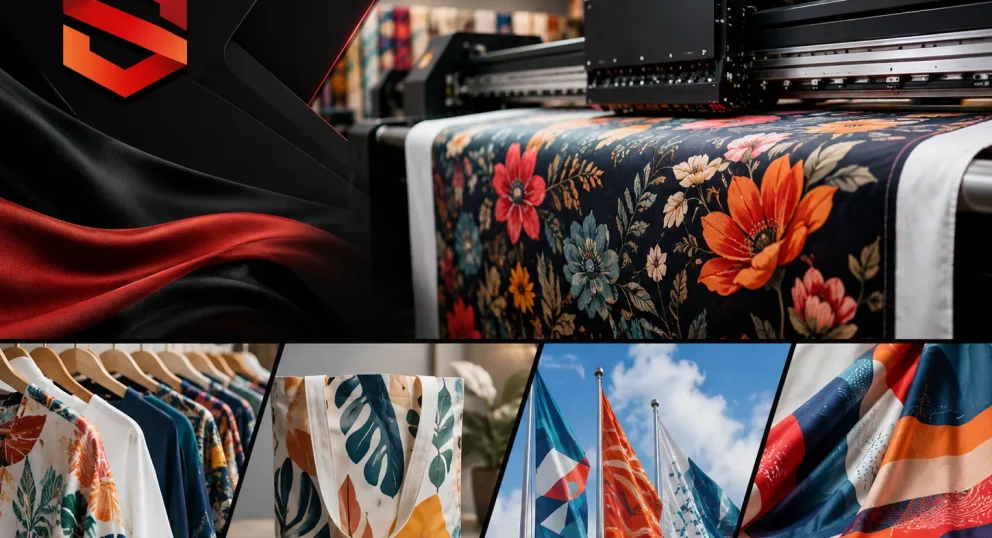

Digital fabric printing has become one of the most important production technologies that companies and brands rely on to obtain customised, high quality products, without being restricted by large minimum quantities or the high setup costs that some traditional printing methods impose.
Whether you manage a clothing brand, an advertising agency, a textile manufacturer, or you are looking to produce uniforms, flags, fabric banners, promotional bags, and textile products carrying your brand identity, digital printing offers great production flexibility, high colour stability, and the ability to execute complex designs with exceptional precision, from initial samples all the way to large-scale commercial production.
At Dar Medhat El Sewedy Printing, since 1998, we continuously invest in advanced digital printing technologies to provide integrated solutions that suit the needs of companies, factories, and brands in Egypt and the Gulf, from initial samples and custom orders through to commercial production in large quantities while maintaining the same level of quality and precision in every batch.
In this guide, you will learn about the concept of digital fabric printing, the most important technologies used, suitable fabric types, the advantages of each technology, the most common commercial applications, as well as the factors that affect cost and the criteria to consider when choosing the right printing partner for your project.
What Is Digital Fabric Printing?
Digital textile printing is a modern technology that transfers designs from a computer directly onto fabrics using specialised high precision printers, without the need for printing screens or separate templates for each colour as required in some traditional printing methods.
This technology has become the preferred choice for many companies and brands, offering production flexibility, fast execution, and the ability to print complex designs and high resolution images with vibrant, stable colours, for both limited production runs and large commercial quantities.
The Difference Between Traditional and Digital Fabric Printing
Digital printing has brought about a major transformation in the textile industry compared to traditional methods, particularly for companies that need greater production flexibility.
-
Production setup
Digital printing does not require preparing separate screens or printing templates, which reduces setup time and initial costs, while traditional printing relies on special preparation for each colour used in the design.
-
Quantity flexibility
Digital printing allows the production of a single piece or thousands of pieces at the same quality level, making it suitable for emerging brands, initial samples, custom orders, and commercial production.
-
Detail and colour quality
Digital printing excels at producing photographic images, subtle colour gradients, and complex designs that are difficult to achieve with some traditional printing techniques.
-
Sustainability and waste reduction
Digital printing consumes less water and ink compared to some traditional printing methods, making it a more efficient and sustainable choice for companies seeking to adopt environmentally responsible production practices.
At Dar Medhat El Sewedy Printing, we help companies and brands choose the most suitable technology for each project, achieving the right balance between print quality, production cost, and the end product’s usage requirements.
Types of Digital Fabric Printing Technologies: Which One Suits Your Project?
1. DTG Printing (Direct to Garment)
The most widely used method for ready-to-wear clothing printing. A printer resembling an office printer but designed to print directly onto t-shirts, hoodies, and ready-made garments, using water-based pigment inks that are environmentally friendly.
Advantages:
- Printing from a single piece with no minimum quantity
- Full colour range and photographic detail
- No template setup costs
- Ideal for customisation, with a different name or design on each piece
Limitations:
- Most suitable for cotton fabrics (100% cotton gives the best result)
- Printing on dark fabric requires a white base layer, which increases cost
- Less economical for very large quantities compared to traditional printing
Best for: customised t-shirts, promotional gifts, sporting events and tournaments, designer samples.
2. Dye Sublimation Printing
Sublimation printing is one of the most widely used techniques in the polyester textile sector. The design is transferred from special paper onto the fabric using heat and pressure, allowing the ink to fuse into the fibres themselves.
The result is colours embedded within the fabric with no surface texture, exceptionally vibrant, and highly resistant to washing, cracking, and peeling.
Advantages:
- Guaranteed colours that don’t fade with use
- No printing texture, making it very comfortable for sportswear
- Full coverage of the piece from the first thread to the last
- More economical for medium and large quantities
Limitations:
- Works only on polyester (100% or a high percentage)
- Does not work on cotton
- Colours on dark fabric are less vibrant
Best for: sportswear, team uniforms, fabric flags and banners, polyester bags.
3. Wide Format Digital Textile Printing
Large printers that print on full fabric rolls at widths reaching 3.2 metres, used to produce hundreds of metres for heavy production runs.
Advantages:
- Suitable for large-scale production by the metre or by weight
- Faster and more economical for large fabric quantities
- Ideal for banners, flags, and large decorative items
Best for: fabric banners for exhibitions, national and institutional flags, tailoring and sewing fabric with printed designs.
4. Traditional Screen Printing: When Is It Still the Best Option?
It is not a digital method, but it cannot be ignored in any comparison. Each colour in the design requires a separate screen, with high setup costs but significantly lower unit costs for very large quantities.
When to choose it: orders above 500 to 1,000 pieces with a simple design and few colours (1 to 3 colours). In this case it is the most cost effective option without question.
When not to choose it: designs with many colours, colour gradients, or small quantities.
Comprehensive Technology Comparison Table
| Criterion | DTG | Sublimation | Wide Format | Traditional Screen |
| Ideal quantity | 1 to 200 | 50 to 5,000 | 100m+ | 500+ pieces |
| Colours | Unlimited | Unlimited | Unlimited | 1 to 8 colours |
| Fabric type | Natural cotton | Polyester | Cotton and polyester | Any fabric |
| Wash resistance | Good | Excellent | Good | Excellent |
| Print texture | Light | No texture | No texture | Raised |
| Setup cost | None | Low | None | High |
| Per-piece customisation | Possible | Not possible | Not possible | Not possible |
How to Choose the Right Technology
Choosing the right digital printing technology depends on several key factors: the type of fabric being used, the quantities required, the degree of colour stability needed, the final product’s intended use, the available budget, and the required production speed.
Digital Fabric Printing Stages
The digital fabric printing process passes through several key stages to ensure the best possible quality.
Pre-treatment: some fabric types undergo initial treatment using materials that help improve ink absorption within the fibres and prevent colour spreading, contributing to clearer and more stable details.
Digital printing: the design is sent directly from a digital file to the printer, where the print heads spray fine droplets of ink onto the fabric surface at the highest levels of colour precision, with the ability to produce millions of colour gradients and complex designs with virtually no restrictions.
Colour curing: after printing is complete, the inks are fixed using heat or steam depending on the ink and fabric type used, to ensure the print resists washing, friction, and daily use.
Best Fabric Types for Each Technology
Print quality in digital printing doesn’t depend on technology alone. The fabric type plays an essential role in determining detail precision, colour stability, the final product’s texture, and its resistance to use and repeated washing.
-
100% Cotton: Best for DTG
Cotton fabrics are among the most commonly used materials in direct-to-garment digital printing, due to their high capacity for absorbing water-based inks and displaying fine details and colours clearly. Cotton fabrics offer a soft, comfortable feel, making them a popular choice for products intended for daily use.
Limitation: printing on black or dark cotton requires a white ink base layer, which increases both cost and time.
-
100% Polyester: Best for Sublimation
Polyester is the ideal choice for sublimation printing, as this technique allows inks to fuse into the fabric fibres themselves, producing vibrant colours and high print stability even with intensive use and repeated washing.
Limitation: sublimation cannot work on cotton. This is not a recommendation but a physical fact.
-
Cotton-Polyester Blends
Blended fabrics combine the properties of cotton and polyester in varying ratios, used in some ready-to-wear garment and promotional product applications.
They offer a good balance between comfort and durability, although final print quality may vary depending on the ratio of natural to synthetic fibres within the fabric, making sample testing before commercial production an important step to ensure the desired result is achieved.
Specialist Materials:
- Satin and silk: digital printing is possible with specialist inks, producing vibrant colours and a luxurious appearance.
- Canvas: for bags, totes, and heavier products, accepts both DTG and wide format printing.
- Microfibre: for sublimation sportswear, lightweight and breathable.
Al Sewedy tip: always request a printed sample on the actual fabric before full production. What looks excellent on screen may appear differently on a different fabric, and a sample prevents the loss of an entire production run.
Applications of Digital Fabric Printing
Customised t-shirts and corporate clothing for companies and events
The most common application. Company uniforms, event and conference t-shirts, sports team clothing, and promotional gifts with a brand logo.
The marketing advantage is clear: every employee wearing the uniform is a moving advertisement for your brand, seen by hundreds of people every day.
Printed fabric bags (Tote Bags)
A powerful and eco-friendly marketing tool. Your customer carries your name everywhere they go, at a cost that cannot be compared to any other advertising medium.
Flags and fabric banners
For exhibitions, events, and corporate interior decoration. More durable than paper, can be stored and reused, and they look professional in any environment.
Sportswear printing
Sportswear, team shirts, yoga clothing. Sublimation is the optimal choice here: colours that don’t fade, no texture that causes discomfort, and excellent breathability.
Customised promotional gifts
Caps, towels, cushions, bags. Digital printing allows each piece to be customized with different content, perfect for gifts with employee or client names.
Digital Fabric Printing Prices in Egypt 2026
The cost of digital fabric printing is one of the most important factors for companies and brands when planning production.
However, there is no fixed price applicable to all projects, given the differences in technologies used, fabric types, required quantities, and final finishing requirements.
Factors That Affect Digital Fabric Printing Cost
Type of printing technology: cost varies between different printing technologies including DTG, sublimation, wide format fabric printing, and direct printing on industrial textiles. Each technology requires different inks, equipment, and production stages that directly affect the final price.
Type of fabric used: fabric is one of the most important cost components, with prices varying between natural cotton, polyester, blended fabrics, and technical or specialist textiles. Fabric density, weight, and pre-treatment requirements also affect production cost.
Order size: one of the key factors determining unit cost. In most cases, the printing cost per piece decreases as the required quantity increases, making commercial production more economically efficient than individual orders or initial samples.
Print coverage area and colour coverage: the design area and number of colours used affect ink consumption and running time, particularly for products relying on all-over printing or designs with fine details.
Finishing and preparation processes: some products require additional stages such as heat treatment, sewing and assembly, cutting and shaping, custom packaging, and quality inspection and control, all of which must be included in the final project cost.
How to Get the Best Production Cost
Companies can improve digital printing costs by: consolidating seasonal orders into a single production run, choosing the right technology for the product type, adopting standard sizes to reduce waste, producing initial samples before commercial production begins, and working with a printing partner capable of managing projects from design through to final delivery.
When Is Traditional Screen Printing More Cost Effective?
For orders above 500 pieces with a design containing only 1 to 3 colours, traditional screen printing delivers the lowest unit cost. For medium quantities or multi-colour designs, digital printing is more economical and delivers better results.
At Dar Medhat El Sewedy Printing, we prepare customised quotes for every project based on actual required specifications, while providing technical consultations that help clients choose the right technology and fabric, achieving the best balance between product quality, production efficiency, and long-term investment cost.
Technical Specifications for Fabric Printing Files
-
Resolution and dimensions
300 DPI minimum is required for sharp details on fabric. Anything below this means a blurry design. The file must be at the actual printing size, with no scaling up or down after submission.
-
Colour system
RGB is used for digital fabric printing, which is the opposite of paper printing. Digital fabric printing generally works in RGB, but confirm with the print house as some technologies require CMYK. If the print is part of a unified visual identity, define the colour code precisely.
Accepted file formats
PNG with transparent background: for logos and isolated designs, the most commonly used format in DTG. PDF or AI: for vector-based designs, sharp at any size. PSD at 300 DPI: for complex designs rich in imagery.
Common Mistakes in Digital Fabric Printing
Mistake 1: Using a low resolution file. A logo downloaded from the internet at 72 DPI prints blurry on fabric. Always use the original file.
Mistake 2: Choosing the wrong technology for the fabric type. Sublimation on cotton does not work. DTG on polyester produces poor results. The fabric determines the technology.
Mistake 3: Ordering a large quantity without a sample. Print 1 to 3 pieces first, review them, approve them, then commit to the full quantity.
Mistake 4: Ignoring the effect of fabric colour on printed colours. Light colours on dark fabric require a white base layer, otherwise they won’t show. Plan for this in your budget.
Mistake 5: Not specifying washing instructions in advance. Prints last longer when washed inside out at low temperature without bleach. These instructions must be communicated to the end user.
Why Dar Medhat El Sewedy Is the Right Partner for Your Project
27 years of experience serving companies and designers
Since 1998, we have served thousands of clients including startups and multinationals, individual designers and major sports chains.
Our experience with the subtle differences between fabrics, inks, and technologies means we understand your project’s requirements before you explain them.
Integrated technologies under one roof
The latest DTG printers, a complete sublimation system, wide format fabric printers, solutions for every quantity and every fabric type and every type of project. There is no need to deal with multiple print houses.
From a single piece to thousands
Complete quantity flexibility. A single piece as a personal gift or sample. Dozens of pieces for an event. Thousands of pieces for a retail chain. All while maintaining the highest quality levels and colour consistency between different batches.
Serving Egypt and the Middle East
Our facility is based in Cairo, serving clients across all Egyptian governorates with organised shipping. For the Gulf market, our export experience ensures your order arrives on time.
Frequently Asked Questions
Is digital fabric printing resistant to washing?
Yes. DTG and sublimation after proper heat fixing are both wash resistant. To preserve colours longer: wash inside out at a cold temperature and avoid bleach.
What is the cheapest way to print t-shirts in bulk?
Above 500 pieces with few colours (1 to 3): traditional screen printing is the most economical. Medium quantities or multi-colour designs: digital is more cost effective and delivers better results.
What is the difference between DTG and sublimation?
DTG prints directly onto ready-made garments and suits cotton. Sublimation uses an intermediate transfer paper and suits polyester only, but offers higher stability and no print texture.
What are the best ink types for fabric?
Pigment inks for DTG on cotton. Dye sublimation inks for polyester. Reactive dyes for large-scale industrial production on cotton.
Conclusion
Digital fabric printing has become a strategic choice for companies and brands seeking greater production flexibility, high colour quality, and fast execution, with the ability to customize products without being restricted to large production quantities.
At Dar Medhat El Sewedy Printing, we have helped companies and brands since 1998 execute digital fabric printing projects to the highest quality standards, from providing technical consultations and choosing the right technology, through producing initial samples and colour testing, all the way to commercial production and project delivery with consistent quality and on agreed timelines.
If you are looking for a partner with the expertise, advanced technologies, and flexibility needed to execute your project, the Dar Medhat El Sewedy team is ready to help you choose the optimal solution and turn your ideas into printed textile products that reflect the strength of your brand.
Email: sales@elsewedyprint.com
Website: www.elsewedyprint.com
Factory: Industrial Zone, 10th of Ramadan City, Egypt
Meta Title: El Sewedy | Digital Fabric Printing Solutions for Businesses
Meta Description: Discover digital fabric printing solutions for businesses and brands, from selecting the right technology to commercial production with consistent colours.