

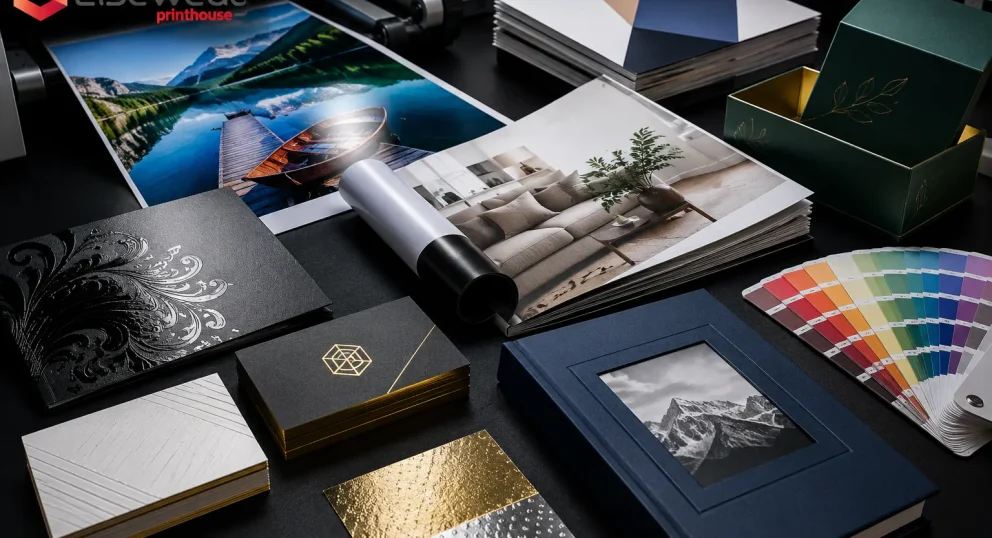

Printing alone isn’t enough. Finishing is what gives a product its real value.
The quality of any printed piece doesn’t reach its potential when the press stops running. Its true value begins with post-press finishing services, which give it a professional appearance, improve the usage experience, and reinforce the brand’s image in front of customers.
At Dar Medhat El Sewedy Printing, since 1998, we provide digital post-press services as part of an integrated production system covering finishing, binding, cutting and forming, and professional packaging, helping companies receive final products that are ready for distribution, display, or sale, with consistent quality and delivery timelines they can rely on.
In this guide, we cover the most important digital post-press services, the technologies used in modern finishing, their impact on final product quality, and the criteria that help companies choose the right printing partner for their projects.
Why Digital Post-Press Services Are an Essential Part of Product Quality
Post-Press Finishing covers every process applied to paper after printing and before delivery, including cutting, folding, surface coating, binding, and any aesthetic or functional addition.
It is the bridge that takes your printed materials from “good” to “exceptional.”
Today, companies and brands rely on professional finishing not just to protect their printed materials, but to highlight their visual identity, improve the usage experience, and increase the perceived value of the product, whether in packaging, catalogues, brochures, books, corporate gifts, or marketing materials.
How Post-Press Services Affect a Brand
Professional finishing plays a direct role in how the customer perceives a product. Precise finishing touches make a printed piece look more professional, help highlight design elements, improve display quality, and strengthen customer confidence in the brand.
In competitive markets, the difference between two similar products can come down to finishing quality, not just print quality.
Do All Printed Materials Need Post-Press Services?
It depends on the nature of the product and its intended use, but most commercial printed materials benefit from a finishing stage, whether to protect against scratches and moisture, extend lifespan, or add visual details that make the piece stand out.
An internal staff document doesn’t need gold stamping. But a book cover, a premium restaurant menu, or a competitive product box is a different matter entirely. Finishing here is not a luxury, it’s a strategic necessity.
Al Sewedy tip: don’t think of finishing as the last step. Plan for it from the design stage. Some finishes like embossing require specific design spaces that cannot be added retroactively.
Types of Digital Post-Press Services
First: Surface Coatings and Lamination
Surface coatings are among the most widely used post-press services because they combine protection with improved appearance, extending a printed piece’s lifespan and giving it higher quality in use.
1. Full UV Varnish
A transparent liquid layer that dries under ultraviolet light. The result is genuine glass-like brilliance with superior protection against scratches and moisture.
When to use it: product catalogues that rely heavily on food or product photography, and any printed piece where you want vivid colours that stand out and attract the eye.
2. Spot UV: Highlighting Elements With Visual Intelligence
The same UV varnish material, but applied only to specific areas, such as the logo, brand name, or product image. The result is an exceptional visual and tactile contrast between the matte surface and the glossy area.
This type of finishing helps create a visual contrast that draws the eye and gives the product a more premium appearance without affecting the rest of the design.
Best for: book covers and catalogues, professional business cards, premium product boxes.
Al Sewedy tip: for best results, ask your designer to prepare a separate file (a Mask) in black that precisely defines the areas where Spot UV will be applied, as a separate file from the original print file.
3. Gloss Lamination
A transparent protective layer covering the printed surface, protecting it from scratches, moisture, and repeated handling, while giving it a more professional appearance.
When to use it: catalogues, brochures, and any printed piece that relies on photography requiring vibrancy.
4. Matte Lamination
Quiet and refined, non-reflective, and gives a soft texture. It creates an impression of understated luxury and professionalism.
It is also the ideal base for applying Spot UV on top, the combination we are asked for more than any other finishing combination.
When to use it: corporate printed materials, premium cosmetics, and any brand looking for an impression of refinement and balance.
- Soft Touch Lamination: The Velvet Texture This is not just a lamination layer. It is an experience. It adds a velvety or peach-skin texture. It gives the product a tactile quality that elevates perceived value and enhances the customer experience.
Best for: professional business cards, premium book covers, chocolate boxes and luxury gift packaging.
- Aqueous Coating Environmentally friendly, fast drying, and safe for use with food and pharmaceutical materials. It provides good protection with a light sheen, less than UV but completely safe.
Best for: food and pharmaceutical product packaging, and any printed piece that needs protection without an excessive gloss.
Second: Premium and Luxury Finishing
Digital post-press services extend beyond protecting printed materials to include advanced finishing techniques that add a visual and tactile dimension reflecting product quality and enhancing the brand’s perceived value.
Many companies rely on these techniques to make their products stand out on competitive shelves and leave a professional impression on customers.
1. Hot Stamping
A heated metal die presses a metallic foil onto the paper. The result is genuine light-reflecting metallic brilliance that no gold or silver ink can replicate.
The difference from “gold printing”: gold printing is ink sitting on the paper’s surface. Hot Stamping is a real metallic foil that fuses with the paper. The difference is visible to any eye.
Best for: perfume and luxury gift packaging, premium wedding and event invitations, premium gift notebooks and agendas.
Al Sewedy tip: Hot Stamping on Soft Touch is an irresistible combination. The velvety matte surface as a background with the metallic shine on the logo: calm and distinction at the same time.
2. Embossing and Debossing
Embossing: The logo or text rises upward from the paper surface, a three-dimensional raised effect you feel before you see it.
Debossing: the element is pressed inward gently, quiet elegance and permanence.
Both transform the printed piece from a purely visual experience into a visual and tactile experience combined.
Best for: premium business cards, book covers and agendas, cosmetics boxes.
Al Sewedy tip: avoid extremely fine details in embossing. A simple, clear design produces a stronger effect. Very thin lines may not appear as intended.
3. Combining Finishes: The Peak of Distinction
In many commercial projects, more than one finishing technique is combined to achieve the best possible result. Common combinations include:
- Matte lamination with Spot UV
- Hot Foil with Embossing
- Soft Touch with metallic stamping
- Spot UV with embossing
A considered combination of these techniques produces printed pieces and packaging with a premium appearance and a usage experience that reflects the product’s value before it is even opened.
Practical example: a luxury perfume box with a Soft Touch cover, the perfume name in Embossing, and the brand logo in gold Hot Stamping. This sensory experience is what justifies a higher price and builds deeper loyalty.
We have more than 27 years of experience combining these finishes. Get in touch to bring your vision to life from the very start.
Third: Cutting and Forming Services
Post-press services also include cutting and forming operations that transform a printed piece into a finished product ready for use, filling, or display.
The precision of this stage depends directly on the quality of equipment used, since it affects the product’s dimensions, assembly ease, and the brand’s final appearance.
1. Die Cutting
A sharp metal die designed to the required shape cuts the paper with extreme precision in any form needed, a card shaped like your logo, a box in an unconventional form, a brochure shaped like your product.
Best for: custom stickers, packaging boxes, and any printed piece that requires a distinctive shape reflecting the brand identity.
2. Kiss Cut
Cut only the top sticker layer without cutting through the backing paper. The sticker peels off cleanly and easily. Ideal for adhesive stickers that are distributed or applied to products.
Best for: packaging and product stickers, promotional stickers, and event stickers.
3. Creasing and Perforating
Creasing: a compressed line in thick paper that allows folding without cracking. Essential for any brochure or catalogue printed on paper above 250 grams.
Perforating: a line of small holes that allows part of the page to be separated easily, used for discount coupons, entry tickets, and any printed piece that needs a separable section.
Fourth: Binding and Assembly Services
Binding and assembly is the final stage before delivering the finished product, transforming printed pages into a complete product that combines durability, ease of use, and a professional appearance.
The choice of binding type depends on the nature of the printed piece, page count, method of use, and the brand’s visual identity.
At Dar Medhat El Sewedy Printing, we provide a varied range of binding solutions suited to different commercial, administrative, and marketing applications.
1. Spiral Binding
Opens 360 degrees and lies completely flat, ideal for intensive use and continuous writing.
Best for: notebooks and catalogues, company reports, any notebook used daily.
2. Perfect Binding (Glue Binding)
Pages are gathered and glued at the spine with thermal adhesive and an outer cover. Gives a professional appearance with a flat spine that can be printed on.
Best for: books and magazines, premium catalogues, official corporate materials.
Al Sewedy tip: in perfect binding, leave a larger inner margin (Gutter) in the design. Part of the page “disappears” into the glued area and important text or elements may be trimmed.
3. Saddle Stitch
Centre stapling for thin booklets. Economical and fast, for booklets up to 64 pages.
Best for: brochures and introductory booklets, event promotional materials.
4. Case Binding (Hardcover)
Inner sections are sewn and covered with reinforced boards faced with fabric, leather, or printed paper. The highest level of binding available.
Best for: premium agendas and corporate gifts, commemorative books, and any printed piece presented as a quality gift.
Finishing Comparison Table
| Finish | Best Use | Relative Cost | Adds Value For |
| Soft Touch | Business cards, doctors, premium boxes | Medium–High | Luxury brands |
| Spot UV | Business cards, doctors, brochures | Medium | Logo highlight |
| Hot Stamping | Business cards, doctors, cosmetics, perfumes, gifts | High | Beauty, perfumes, gifts |
| Gloss Lamination | Catalogues, brochures, food menus | Low | With Spot UV on top |
| Matte Lamination | Business cards, doctors, booklets | Low | All categories |
| Die Cut | Stickers, boxes, promotional | Medium | Products needing distinction |
| Embossing | Business cards, doctors, premium notebooks | High | Corporate gifts |
| Aqueous Coating | Food packaging, environmental | Low | Pharmaceutical and eco products |
Common Mistakes When Choosing Digital Post-Press Services
Choosing a finish that doesn’t suit the product’s nature
Not all finishes are appropriate for every type of printed material. Choosing a luxury finish for an everyday product, or using a protective coating unsuitable for the intended use, can increase costs without delivering real value.
Not accounting for the paper type or material
The success of many finishes depends on compatibility with the paper type used. The paper material should be defined from the design stage to ensure the best outcome after printing and finishing.
Overusing finishing techniques
Combining too many finishes in a single product can dilute the design and weaken the visual identity rather than strengthening it. In many cases, a simple and considered finish is more impactful than using multiple techniques simultaneously.
Ignoring the finishing stage during file design
Some finishes, such as Spot UV, Hot Foil, or Embossing, require separate files or specific margins and spaces during design. When these requirements are overlooked, differences can appear between the expected design and the final product.
Relying on multiple suppliers for the same project
Having printing and finishing executed by different suppliers can cause delivery delays, inconsistent quality standards, and difficulty tracking the project. Many companies prefer working with a single provider that has an integrated production system from printing through to final finishing.
Al Sewedy tip: the best printing results begin before the machines start running. We always recommend discussing the product type, material, and required finishes from the planning stage, so the most appropriate solutions can be chosen that achieve the right balance between quality, cost, and execution speed.
Why Choose Al Sewedy Printing for Digital Post-Press Services?
The problem we solve
The biggest challenge facing companies in Egypt and Saudi Arabia is fragmentation between separate printing houses and finishing workshops.
This fragmentation causes delivery delays, conflicting quality standards, and colour matching problems between production stages.
The solution: everything under one roof
Our factory in the 10th of Ramadan, Egypt’s most important industrial city, houses the latest offset and digital printing machines alongside a complete department for all post-press services, including full and spot UV varnish, gloss, matte, and Soft Touch lamination, gold, silver, and copper Hot Stamping, Embossing and Debossing, custom Die Cut and Kiss Cut, and all binding types including spiral, glue, stitch, and hardcover.
Your project does not leave our factory until it is completely ready for delivery, to the same quality standards at every stage.
Consistent quality across all production stages
We rely on quality control systems that monitor the project at every stage, from printing through to final finishing, to ensure accurate execution, colour stability, and product quality before delivery.
Faster execution and lower operational costs
Executing all project stages within a single production facility helps reduce execution time, minimise errors between suppliers, lower operational costs, and simplify project tracking from start to delivery.
This gives our clients greater flexibility in managing their projects, particularly for commercial volumes or marketing campaigns requiring strict deadline compliance.
Experience across multiple sectors
Since 1998, Dar Medhat El Sewedy has helped companies, factories, and brands execute thousands of projects requiring the highest quality levels in printing and finishing across food, cosmetics, pharmaceuticals, retail, education, and the corporate sector.
Serving Egypt, Saudi Arabia, and the Middle East
From our factory in the 10th of Ramadan, we serve clients across all Egyptian governorates and export regularly to the Saudi and Gulf market. Saudi companies printing with us save 30 to 45% including shipping compared to local printers, at the same quality or higher.
Frequently Asked Questions
What is the difference between UV varnish and aqueous coating?
UV varnish dries under ultraviolet light and delivers strong glass-like brilliance with superior protection. Aqueous coating dries in air, is food-safe and environmentally friendly, but has a lighter sheen.
For food and pharmaceutical materials choose aqueous. For catalogues and premium printed materials choose UV.
Can Spot UV be applied to digital printing?
Yes. Spot UV is applied after printing regardless of the technique used, whether offset or digital. The key requirement is that the file is prepared with a separate Mask that precisely defines the areas of application.
Do finishing techniques increase delivery time?
Yes. Each finish adds drying and application time. Hot Stamping and Embossing require custom dies that need advance preparation. Plan by adding 2 to 5 working days depending on the type of finishing.
How do I determine the right finish for my printed materials?
Three questions determine the answer: what impression do you want to leave? Who is your target audience? What is your budget? Our team helps you answer these and suggests what is most appropriate for your specific situation.
What is the minimum quantity for Hot Stamping?
Hot Stamping requires a custom metal die, a fixed preparation cost regardless of quantity. Economically, it starts to justify itself from 500 to 1,000 pieces and above. For smaller quantities, Spot UV is more cost-effective.
Conclusion
Digital post-press services play an essential role in transforming printed materials into professional products that reflect brand quality and enhance the customer experience.
Choosing the right finish, precise execution, and quality assembly all directly affect the final value of the product, whether it is packaging, a catalogue, a book, or a marketing material.
At Dar Medhat El Sewedy Printing, we provide integrated post-press solutions covering surface coatings, premium finishes, cutting and forming, binding, and professional packaging, within an integrated production system that ensures quality, fast execution, and consistent results at every stage of the project.
If you are looking for a partner with the expertise and technologies needed to execute all printing and finishing stages with efficiency and professionalism, the Dar Medhat El Sewedy team is ready to help you choose the right solutions and turn your ideas into finished products that reflect the strength of your brand.
Email: sales@elsewedyprint.com
Website: www.elsewedyprint.com
Factory: Industrial Zone, 10th of Ramadan City, Egypt
Get in touch today for a free consultation and a custom quote covering your project from printing to final finish.