


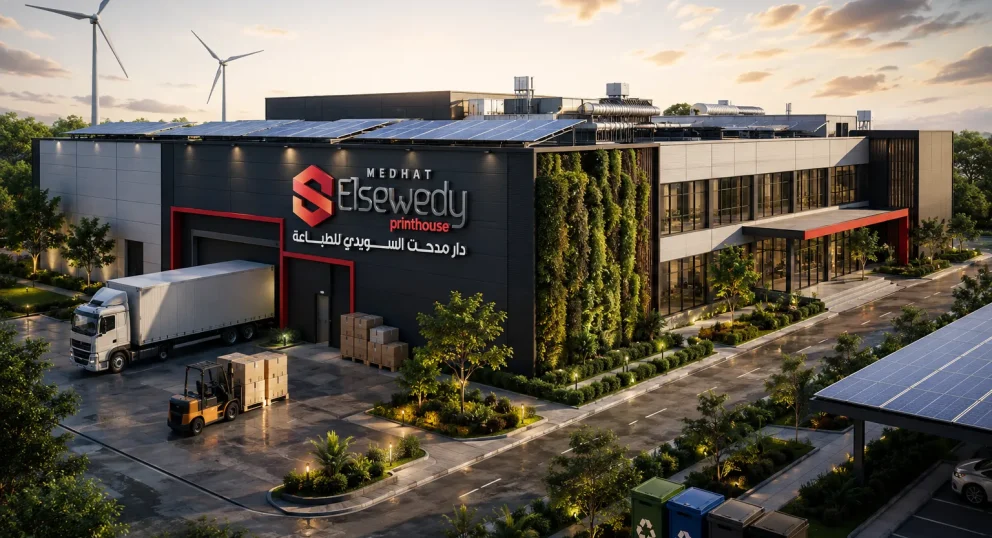

The concept of an eco-friendly factory is no longer just a marketing slogan.
It has become a fundamental standard for companies and brands looking for production partners more committed to sustainability, waste reduction, and responsible resource use within manufacturing operations.
If you’re looking for a factory that combines print quality, use of certified materials, improved energy efficiency, reduced environmental impact, and investment in more sustainable solutions, this is the direction Al Sweidy Printing is actively developing as part of its vision for the future of green and sustainable printing.
At Al Sweidy Printing, we believe that the future of the industry depends not only on production quality, but on the ability to achieve balance between operational efficiency, environmental responsibility, and the requirements of modern markets.
We continuously work on developing a more sustainable production system based on certified materials, improved resource efficiency, and support for a gradual transition toward clean energy sources, within a clear vision extending to 2027.
In this article, we present what an eco-friendly factory means within the printing industry, the steps Al Sweidy is taking to support sustainability, and how this direction can add real value for companies and brands looking for production partners that are ready for the demands of the future.
What Does an Eco-Friendly Factory Mean in the Printing Industry?
The concept of an eco-friendly factory isn’t limited to using recyclable materials alone. It encompasses an integrated system aimed at reducing the environmental impact of production operations while maintaining product quality and operational efficiency.
In the printing and packaging sector, an eco-friendly factory relies on a set of practices that include:
- Using raw materials certified from responsible and sustainable sources
- Relying on inks and materials with lower environmental impact
- Improving energy consumption efficiency within production lines
- Reducing waste and losses during manufacturing operations
- Recycling industrial waste wherever possible
- Investing in clean energy sources and more efficient production technologies
These standards have today become a core part of the requirements of many global companies and major brands, particularly in sectors that depend on export or adopt sustainability policies within their own supply chains.
Why Has the Eco-Friendly Factory Become an Important Standard for Companies?
With growing attention to sustainability and environmental responsibility, many companies now prefer to work with suppliers and production partners that apply more sustainable standards in their operational processes.
This isn’t only about protecting the environment. It also includes:
- Improving brand image
- Supporting corporate sustainability goals (ESG)
- Facilitating compliance with the requirements of certain international markets
- Reducing waste and improving resource efficiency
- Building more sustainable and stable supply chains
Choosing an eco-friendly factory is no longer just an environmental responsibility decision. It has become a strategic decision for many companies planning to grow and operate according to the requirements of modern markets.
How Al Sweidy Applies the Eco-Friendly Factory Concept
Talking about sustainability is easy. Application is the real test. At Al Sweidy Printing, our environmental commitment has been part of our daily operations for years, not a future promise.
1. Plant-Based Inks
We have shifted primarily to inks derived from plant-based sources such as soy oil. These inks reduce volatile organic compounds (VOCs) that are harmful to both the environment and human health.
They also make printed paper easier to recycle because they’re simpler to remove. And they deliver more vibrant and stable colors on paper, combining environmental responsibility with superior quality.
2. FSC-Certified Paper
Every sheet that enters our factory is certified from sustainable and reliable sources. The FSC (Forest Stewardship Council) certification guarantees that the paper used comes from responsibly managed forests that preserve biodiversity and workers’ rights.
This means that the corporate paper printing we execute doesn’t contribute to deforestation. It supports a responsible lifecycle for natural resources.
3. Machine Efficiency Improvement
Our modern Heidelberg and Komori machines are programmed to automatically optimize ink and energy consumption. Less waste at the start of each print run means fewer wasted resources and a lower cost for the client.
Expert insight: when choosing a printer, ask directly what type of inks they use and whether their paper is FSC certified. The answer tells you everything about their genuine environmental commitment.
Looking for high-quality eco-friendly printing? Contact Al Sweidy’s experts now for a free consultation.
Within Our Vision Toward 2027: The Goal of Transitioning to 20% Solar Energy
This is our most significant announcement in our environmental journey.
The goal: to cover 20% of total energy consumption at Al Sweidy Printing’s factory with clean solar energy by the first half of 2027.
This direction forms part of a broader strategy aimed at improving energy consumption efficiency, reducing dependence on traditional energy sources, supporting sustainability plans within the factory, and building a production model more aligned with the demands of the future.
Why 20% Specifically?
This number didn’t come from nowhere. After extensive engineering studies, we found that 20% achieves the ideal balance between three factors.
A tangible environmental impact: a real reduction in carbon emissions that can be measured and reported to our clients.
Production continuity: guaranteeing zero interruption to production lines, particularly the largest digital printing machine in Egypt that we operate.
Economic viability: an investment that delivers a genuine return over the medium term.
In Numbers: What Does 20% Solar Energy Actually Mean?
Reducing carbon dioxide emissions by approximately 150 tons annually. This is equivalent to planting more than 2,500 trees every year, or removing approximately 30 cars from the road for an entire year.
Compared to traditional printing factories that rely 100% on fossil fuels, our factory becomes a model of efficiency and responsibility within the printing industry in Egypt and the Middle East.
The Effect on Cost Stability
Solar energy is not just an environmental decision. It is a smart economic investment. Partial independence from the traditional electricity grid means reducing the impact of energy price fluctuations on our production costs, price stability for our clients over the long term, and a competitive advantage that makes us more flexible in facing any economic changes.
Be a partner in our green vision. Contact us today to start your next project.
How Choosing an Eco-Friendly Factory Reflects on Your Brand
You might ask: “What does my printing facility’s solar energy plan have to do with me as a brand owner?”
The answer is a direct and strong connection, at three levels.
1. Strengthening Brand Image
You can proudly tell your customers: “Our product packaging was printed in a factory that uses clean energy and safe plant-based inks.”
In a market where consumers are increasingly environmentally aware, this statement could be the decisive selling point that differentiates you from your competitors.
Expert insight: a simple line on your product packaging such as “printed with clean energy and safe plant-based inks” can be the key to a purchase decision for a growing segment of consumers.
2. Export Market Doors Open for You
European and American markets are increasingly requesting environmental certifications from their suppliers. Your partnership with a printer using FSC paper, plant-based inks, and renewable energy makes it easier for you to meet these requirements.
Egyptian companies exporting to the Gulf that work with us receive documents proving our environmental commitments, documents that open new doors for them.
3. Reinforcing Your Brand Image as a Responsible Institution
Associating with a supplier that embraces sustainability directly reflects on your brand’s image. In corporate social responsibility (CSR) reports, “we work with environmentally certified suppliers” has become a statement that is evaluated and that influences the financial rating of major companies.
At Al Sweidy Printing, we believe that sustainability is no longer an optional addition. It has become part of the future of the industry and modern supply chains, which is why we continue developing our operations to help our clients build brands better prepared for the requirements of the future.
Comparison: Green Printing vs. Traditional Printing
| Criteria | Al Sweidy (Green) | Traditional Printer |
| Ink type | Plant-based | Traditional chemical |
| Paper source | FSC certified | Undocumented |
| Energy source | 20% solar + grid | 100% grid |
| Environmental certificates | Available for client | Rare |
| Product export viability | Higher acceptance | May face restrictions |
| Brand image | Responsible and forward-thinking | Traditional |
| Long-term cost | More stable | Affected by energy prices |
Common Mistakes in Understanding Green Printing
With growing interest in sustainability, many companies have begun using terms like “green printing” and “eco-friendly factory,” but not everything said reflects genuine practices on the ground.
It’s important to evaluate partners and suppliers based on clear, measurable actions rather than marketing slogans alone.
Mistake 1: Believing that sustainability always means higher costs
Some believe that working with an eco-friendly factory necessarily leads to higher costs, when in reality many sustainability practices actually help improve operational efficiency, reduce waste, and raise resource utilization efficiency over the long term.
Mistake 2: Believing that sustainable printing affects final product quality
Modern printing technologies, advanced inks, and certified materials can now deliver quality levels that match or exceed many traditional solutions, without any need to sacrifice performance or final appearance.
Mistake 3: Focusing only on raw materials
The eco-friendly factory concept isn’t limited to the type of paper or inks used. It also encompasses energy consumption efficiency, resource management, waste reduction, and long-term development plans within the factory.
Mistake 4: Relying on environmental slogans without verifying actual practices
When evaluating any factory or production partner, it’s important to ask about the actual procedures being applied within the facility, such as sustainability policies, raw material sources, and energy efficiency improvement plans, rather than settling for general marketing messages.
Al Sweidy: A Model for Green Printing in Egypt and the Middle East
Who Do We Serve?
Choosing an eco-friendly factory has become a strategic decision for many companies and brands looking for production partners that combine quality, operational efficiency, and environmental responsibility.
At Al Sweidy Printing, we work on developing this model through a production system that places sustainability as part of the continuous development process, not as a temporary initiative or marketing trend.
- In Egypt: pharmaceutical, food, and cosmetics companies that need compliance with safety and environmental standards.
- In Saudi Arabia and the Gulf: brands exporting to international markets that need environmental certifications to support export operations.
- In European export markets: companies that need documented environmental suppliers as a condition for contracts with major retail chains.
A More Sustainable Production System
We rely on a set of practices aimed at improving resource utilization efficiency and reducing the environmental impact of printing and packaging operations, from raw material selection through production management to energy development plans within the factory.
Investment in the Future of Clean Energy
Within our 2027 vision, we are working to support a gradual transition toward using solar energy as part of the factory’s operational energy needs, a step aimed at reinforcing sustainability and improving energy consumption efficiency over the long term.
Supporting Companies and Brands That Embrace Sustainability
We aim to help our clients build products and brands more aligned with the requirements of modern markets, by providing printing and packaging solutions that respect both quality and sustainability simultaneously.
Industrial Expertise Since 1998
For more than 27 years, Al Sweidy Printing has been developing its production capabilities and industrial technologies to serve companies, factories, and brands in Egypt and regional markets, while maintaining the balance between quality, production flexibility, and continuous development.
Are you ready to be part of the green future? Contact Al Sweidy Printing today to plan your next project with environmental standards worthy of your brand.
Frequently Asked Questions
What does an eco-friendly printing factory mean?
A factory that uses safe plant-based inks instead of chemical ones, uses paper from certified sustainable sources (FSC), operates partially on renewable energy, and minimizes resource waste at every production stage, while being able to provide documents proving these commitments.
How does an eco-friendly factory differ from a traditional one?
An eco-friendly factory relies on practices aimed at improving resource and energy efficiency and reducing waste and emissions as much as possible, while traditional factories typically focus on production alone without giving the same priority to environmental sustainability standards.
Does green printing affect the quality of the final product?
No. In fact, the opposite is true. The plant-based inks we use produce more vibrant and stable colors. FSC-certified paper carries higher production standards. Quality and environmental responsibility go hand in hand.
How does my brand benefit from choosing a green printer?
Three direct benefits: your product carries a positive story that differentiates you in marketing. It facilitates obtaining environmental certifications for export.
And it strengthens your brand’s image as a responsible institution in a market where consumers care about sustainability more than ever.
Is green printing more expensive?
In the short term there may be a slight difference in some materials. But over the long term, energy and resource efficiency reduces costs, which benefits the client. Additionally, the marketing value added to the brand far exceeds any cost difference.
Do you provide environmental documents for clients?
Yes. Paper source certificates (FSC) and documentation of the inks used are available with every production batch for clients who need them for sustainability reports or export requirements.
Conclusion
An eco-friendly factory isn’t a sign we hang on the factory gate. It is a daily commitment that begins with choosing the ink and ends with the solar energy plan.
At Al Sweidy Printing, we don’t just print paper. We print our mark on the future. Our environmental journey is crowned by the goal of 20% solar energy by 2027, a promise we make to our clients and to our planet.
Choosing us isn’t just a business transaction. It’s joining a vision that believes superior quality and environmental responsibility can go hand in hand in Egypt and the Middle East.
If your company is looking for an eco-friendly factory that combines industrial expertise, production quality, and a clear vision for a more sustainable future, Al Sweidy Printing is ready to be part of that journey.
📧 Email: sales@elsewedyprint.com
🌐 Website: elsewedyprint.com
📍 Factory: Industrial Zone, 10th of Ramadan City, Egypt