


In large-scale projects, printing is not just an execution step. It is a core part of the product’s quality itself. A slight color inconsistency, unstable quality between print batches, or a delivery delay can cause significant losses, particularly in sectors like pharmaceuticals, food, and cosmetics.
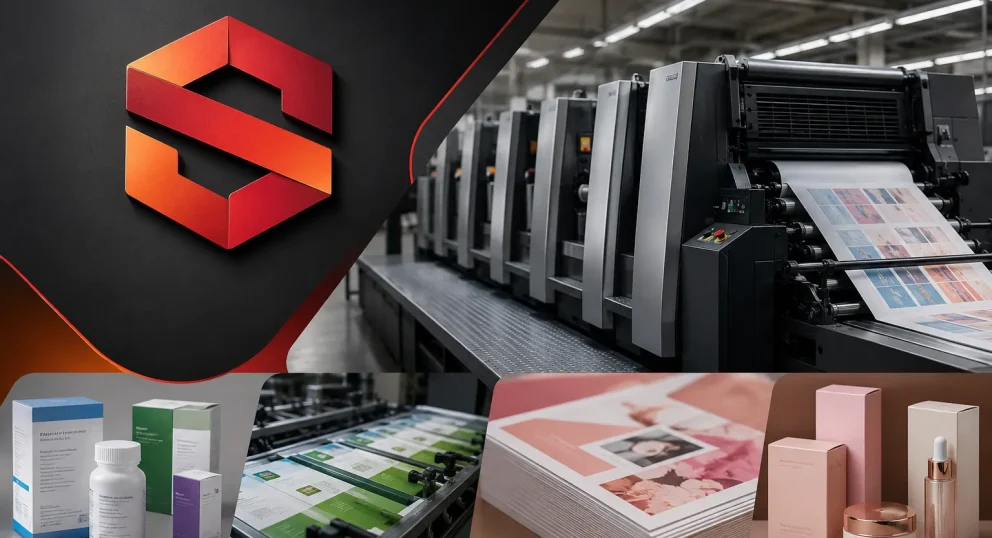
This is why companies today rely on modern offset printing presses capable of delivering consistent quality, fast production, and professional finishes that meet the demands of commercial-scale output.
Despite the major advances in digital printing, offset printing remains the stronger choice for projects requiring large quantities and precise color quality at an economical cost per copy.
But the real difference isn’t just about owning modern machines. It’s about a printing facility’s ability to manage production efficiently, maintain consistent quality, and execute large-scale projects without errors that affect the final product or the brand’s image.
In this guide, you’ll learn how modern offset printing presses work, when offset is the better choice over digital printing, the most important criteria for selecting an offset printer for your project in 2026, and the latest printing techniques and finishes used in modern commercial production.
At Al Sweidy Printing, operating since 1998, we work with pharmaceutical, food, cosmetics, and export companies through an integrated industrial facility in 10th of Ramadan City, one of Egypt’s most important industrial and production centers, delivering modern offset solutions that combine quality, speed, and the capacity for large-scale production with consistency and professionalism.
What Is Offset Printing and How Does It Work?
Offset is an indirect printing technique. The ink doesn’t transfer from the plate directly to the paper. Instead, it passes through a rubber intermediary called a blanket. This intermediate step is the secret behind its exceptional quality.
The Stages of the Offset Printing Process
Plate making uses CTP (Computer-to-Plate) technology, where the design is laser-etched onto an aluminum plate for each color in CMYK. The etched areas attract ink while the rest attract water.
During the inking and dampening stage, the plate first passes over dampening rollers to prevent ink from sticking to non-printing areas, then over ink rollers that adhere only to the printing zones.
The inked plate is then pressed against a rubber-covered cylinder, which transfers the image onto it in reverse.
When paper passes between the rubber cylinder and the impression cylinder, the image transfers correctly onto the paper. The result is sharp printing, consistent colors, and fine detail.
The CMYK System: The Secret Behind Vivid Colors
Four base colors, Cyan, Magenta, Yellow, and Black, are printed as microscopic dots in varying proportions layered on top of each other to produce millions of color variations.
For critical colors such as a brand’s logo, pre-mixed Pantone inks are added to achieve absolute color matching that never changes from one batch to the next.
Advantages of Modern Offset Printing Presses
The printing industry has undergone significant development in recent years. Modern offset presses now operate with greater precision, speed, and efficiency compared to older traditional machines.
This evolution hasn’t only affected print quality. It has also transformed how commercial production is managed entirely, especially for projects requiring large quantities and consistent quality.
Today, companies aren’t just looking for a printer to fulfill an order. They’re looking for a production partner capable of maintaining consistent quality, reducing waste, accelerating delivery, and guaranteeing color accuracy across every print batch.
Quality That Doesn’t Change Between Copies
This is the advantage that makes offset indispensable in certain sectors. The same quality, the same colors, and the same precision from the first copy to the millionth.
For brands that care about maintaining their visual identity consistently across millions of units over years, this color stability isn’t an added bonus. It’s a fundamental requirement.
Per-Copy Cost Decreases with Quantity
One of the most important strengths of modern offset presses is their ability to produce large quantities at very high speed while maintaining the same quality level.
Although the initial setup cost in offset is higher than digital printing due to plate preparation and machine calibration, the cost per copy decreases significantly as quantity increases.
This makes offset printing the most economical choice when executing catalogs, packaging, brochures, magazines, and large-volume marketing materials, and this is the fundamental difference from digital printing at high volumes.
What Materials Do Modern Offset Presses Support?
One of the key advantages of modern offset presses is their ability to print on multiple materials with consistent quality, including coated paper, duplex and cardboard, kraft paper, packaging materials, and some lightweight plastics.
They also support professional finishes that add greater value to the final product, such as glossy and matte lamination, UV varnish, Spot UV, gold and silver hot stamping, and embossing and debossing.
These finishes don’t just give the product a better appearance. They also raise the perceived value of the brand and make printed materials look more professional and premium.
Integration with Finishing Lines
Offset production lines integrate smoothly with finishing stages including water-based varnish for protection, glossy or matte lamination, gold or silver hot stamping, and embossing or debossing, all as part of a single integrated production line.
Thanks to modern control systems and digital calibration technology, modern offset presses have become more precise in color and production management, which reduces printing variations, color errors, paper and ink waste, and reprinting problems.
This matters greatly for large projects that depend on meeting deadlines with consistent quality across every production batch.
When to Choose Offset Over Digital Printing?
This is the question that determines both the cost and quality of your project simultaneously.
Quantity Is the Primary Criterion
- Below 500 copies: digital printing is more economical, with no setup costs, faster delivery, and flexible revisions.
- 500 to 1,000 copies: a grey zone where calculating the cost for each technology based on your specific quantity is necessary.
- Above 1,000 copies: offset starts to outperform economically, and the gap widens with every additional thousand units.
- Above 10,000 copies: there is no real comparison. Offset is the only logical choice.
Products Best Suited for Offset
Pharmaceutical packaging requires absolute color accuracy, clear text, pharmaceutically safe inks, and zero tolerance for compromise.
Food product packaging requires Food Grade approved materials, vibrant colors that sell on the shelf, and production in millions of units.
Company catalogs require sharp photographic images, consistent colors that reflect visual identity, and large quantities at reasonable cost.
Cosmetics packaging requires luxury finishes, precise Pantone colors, and consistency guaranteeing all batches match.
Annual planners and calendars require large quantities, unified printing, and wide distribution.
Export materials require international standards, quality worthy of foreign markets, and compliance certifications.
When Is Digital Printing the Better Choice?
Digital printing is more suitable for small or fast projects that don’t require large quantities. It’s the best choice for limited quantities, fast printing, test samples, variable data printing, and continuous design revisions.
Its most important advantage is the absence of an initial setup cost like printing plates, which makes it more economical for small quantities. But as quantity increases, the per-copy cost rises significantly compared to offset.
How to Evaluate an Offset Printer Before Signing a Contract
Choosing the right offset printer should not depend on price alone. In large commercial projects, any issue with quality, delays, or color inconsistency can directly affect the product itself and the brand’s image in front of customers.
This is why major companies aren’t just looking for the cheapest printer. They’re looking for a production partner capable of executing the project with consistent quality, clear commitment, and a real ability to manage large-scale production without errors.
Three Non-Negotiable Criteria
First, certifications and compliance: does the printer hold ISO 9001 or an equivalent certification? For regulated sectors like pharmaceuticals and food, these certifications are not a luxury. They are a guarantee of production and safety standards.
Second, experience in your sector: a printer specializing in pharmaceutical packaging understands that sector’s strict requirements in a way a general printer doesn’t. Ask directly whether they have experience in your field and request examples.
Third, physical samples are not just photos: don’t settle for images of past work. Request physical samples. Feel the paper quality with your hands, examine color sharpness, and test the finish’s durability. What you can touch is more truthful than what you see on a screen.
Questions to Ask Before Signing
About machines: what are your most recent machines and what is the maximum production speed you can achieve?
- About quality: how do you guarantee color consistency between different production batches and what color management system do you use?
- About proofing: will I receive a printed sample for approval before full production begins?
- About timing: what is the average delivery time for a project of my scale and what happens in emergency situations?
- About compliance: do you hold certifications for regulated sectors and are your inks and materials approved for food or pharmaceutical use?
- About flexibility: can design revisions be accommodated after setup has begun and what is the additional cost?
Warning Signs Not to Ignore
A printer that doesn’t offer a proof before production, the absence of any documented quality certifications, prices that are unrealistically low without any logical explanation, a lack of clarity about machine specifications or team expertise, and an inability to provide physical samples of comparable work.
Types of Offset Machines and What Distinguishes Each
Sheet-Fed Offset
Prints on pre-cut paper in defined sizes. The most common type for packaging, catalogs, and brochures. Distinguished by high precision and the ability to handle heavier paper and cardboard weights.
Best for: pharmaceutical, cosmetics, and food packaging, catalogs and brochures, and books in large quantities.
Web Offset (Heatset)
Prints on paper rolled on a reel at exceptional speed and uses heat to fix ink quickly. Ideal for very large-scale production.
Best for: magazines and newspapers, books in quantities of millions, and print materials requiring extraordinary production speed.
CTP Technology (Computer-to-Plate)
This is not a separate machine type but rather the plate preparation method. Instead of traditional chemical processing, the design is laser-etched directly onto the plate. The result is higher precision, shorter setup time, and fewer chemical processes.
Printers using CTP deliver better quality and faster setup than those still using traditional methods.
Technical Specifications for Preparing an Offset File
An incorrectly prepared file means production delays or a result far below expectations.
Core Requirements
300 DPI minimum for all images and visual elements. Anything below this means blurry images in the final product.
CMYK color system, not RGB. Screens display colors that ink cannot reproduce, so convert to CMYK from the very first moment of design.
Bleed of 3 to 5 mm outside the actual design boundaries to avoid white edges after cutting.
Safe Zone of 5 mm inside the design boundaries with no text or critical information outside this area.
Pantone colors with a specific Pantone code defined for every critical color in the visual identity, guaranteeing absolute matching across all batches.
Accepted File Formats
High-quality PDF is the best option and preserves all design elements with complete accuracy. AI (Adobe Illustrator) works for vector-based designs including logos and geometric elements.
PSD files for image-rich designs must be at 300 DPI and CMYK, mandatory. Die-cut and fold lines must be placed in a separate layer and not as part of the printed design.
Pre-Submission Checklist
| Criteria | Requirement |
| Image resolution | 300 DPI minimum |
| Color system | CMYK |
| Bleed margins | 3 to 5 mm |
| Safe zone | 5 mm |
| File format | PDF or AI |
| Fonts | Converted to Outlines |
| Critical colors | Specific Pantone code defined |
| Cut lines | In a separate layer |
Al Sweidy Printing | Expertise in Modern Offset Presses Since 1998
When companies look for modern offset presses, they’re not just looking for advanced printing machines. They’re looking for a production partner capable of maintaining quality, meeting deadlines, and managing large projects efficiently and consistently.
At Al Sweidy Printing, since 1998 we’ve delivered professional offset printing solutions serving sectors that demand the highest levels of precision and quality, from pharmaceuticals and food to cosmetics and export.
Over the years, the core focus has extended beyond executing print jobs to building an integrated production system capable of meeting the demands of the modern industrial market.
What genuinely sets Al Sweidy apart includes the latest European offset machines, an integrated production line from printing through finishing, deep expertise in pharmaceuticals, food, cosmetics, and export sectors, and multi-stage quality review before every delivery.
Why Do Major Companies Rely on Al Sweidy?
Because large-scale projects need more than just a printer. They need a partner who understands the importance of quality consistency between production batches, color accuracy, deadline compliance, minimizing errors and waste, and professional handling of large-scale projects.
This is why companies in sectors including pharmaceuticals, food industries, cosmetics, and commercial export packaging rely on Al Sweidy for their printing and production projects.
Quality Is Not a Stage. It Is a Complete Production System.
In modern offset presses, quality doesn’t depend solely on the machine. It depends on every step within the production process, from file preparation and color calibration through final finishing and delivery.
Al Sweidy operates an integrated production system that ensures precise pre-print review, professional color calibration, quality monitoring during production, and a final inspection before delivery, to guarantee the client receives a final product that reflects their brand’s quality exactly as expected.
Frequently Asked Questions
What’s the difference between offset and digital printing?
Offset uses metal plates and liquid ink, making it ideal for large quantities above 1,000 copies where the per-copy cost drops significantly. Digital prints directly from the file and is economical for small quantities without any initial setup cost.
What is the economical minimum for offset printing?
Typically 500 to 1,000 copies. Below that, digital is more economical. Above that, offset begins to outperform economically by a clear margin.
Is offset more expensive than digital?
The initial setup cost is higher, but the per-copy cost at large quantities is far lower. For large-scale production, offset saves money and raises quality simultaneously.
What paper types are available for offset printing?
Glossy and matte coated paper, duplex and heavy cardboard, kraft paper, specialized pharmaceutical papers, and some types of lightweight plastic.
How do you guarantee color consistency between batches?
Through an ICC Profile color management system and Pantone inks with defined color codes, guaranteeing color matching on every order regardless of how far apart the production dates are.
Conclusion
Choosing the right offset printer isn’t only about price or proximity. It’s about the printer’s ability to execute your project with consistent quality, high color precision, and a genuine commitment to deadlines, especially when large-scale commercial production is involved.
Modern offset printing presses have become a core component of success for brands that depend on professional packaging, catalogs, boxes, and high-quality marketing materials.
With the significant advances in printing technology, the real difference between printing facilities no longer lies only in the machines. It lies in the expertise, quality management, and the ability to execute large-scale projects without errors that affect the final product.
At Al Sweidy Printing, this is what we’ve delivered since 1998, without empty claims. Contact us for a consultation and a price quote for your project in less than 24 hours.