


The biggest source of worry in printing projects is not the cost or the timeline. It is watching your project disappear into a production process you cannot see, with no visibility until the moment of delivery.
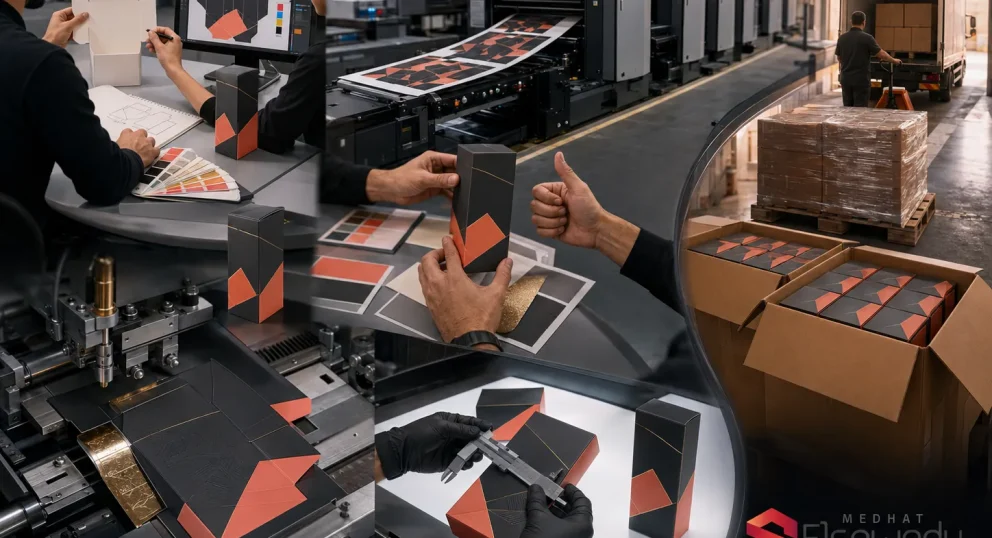
At Medhat Elsewedy Printing House, we believe that trust starts with transparency. That is why we do not treat printing as a closed box hidden from the client. It is a clear, well defined journey that can be followed and understood from the first consultation all the way to receiving the final product.
Since 1998, Elsewedy has worked with hundreds of companies, factories, and brands in Egypt and regional markets. One of the main reasons these relationships have lasted is a clear working process, consistent quality, and the ability to catch potential problems before they turn into costs or delays for the client.
In this article, we walk through the seven stages that every project goes through at Elsewedy, starting with understanding the need and reviewing technical files, moving through samples, production, and finishing, and ending with final inspection and delivery.
A good product is not made by chance. It comes from a clear process, accumulated experience, and a system you can rely on.
Stage One: Consultation. Your Project Starts With Understanding, Not a Price Question
Every successful project starts with the right question. Before any machine runs, a conversation happens first.
When you reach out to us, the first question is not “what do you want to print“. It is “what do you want this product to achieve”.
- Is the goal to build a premium image for a new brand?
- Is the priority to reduce the unit cost on a large production run?
- Is the product intended for export?
- Will it sit on a store shelf or be used inside an industrial setting?
Is it a luxury box for a high end product, or an information booklet that will be distributed in large numbers at an event, or corporate print material that reflects a complete brand identity? The answer shapes everything, the material, the technique, the finish, and the budget.
What Happens in the First Consultation?
You may come to us with an idea about a certain material you saw somewhere. Our experience of more than 28 years may point you toward an alternative material that gives the same effect at a lower cost, or a more durable material that better suits how your product will actually be used.
During the consultation stage, the Elsewedy team works to understand several key elements:
- The nature of the product and the target market.
- The expected production volume.
- How the final printed product will be used.
- Packaging, storage, or shipping requirements.
- The target budget for the project.
- Priorities between cost, appearance, and speed of execution.
We help you decide on the right paper type for your product, the most suitable technique between offset and digital based on your quantity, the finishes that achieve the effect you want within your budget, and a realistic timeline for your project.
These details help us build a solution that actually fits the project, not just a literal execution of what was written on a print request.
This is why we treat the consultation stage as part of the design and production process, not just an administrative step before issuing a quote.
Advice from the Elsewedy team: The clearer the information about your project from the start, the more accurate the production decisions become, and the fewer changes or surprises you will face during execution.
Do not hesitate to share your approximate budget with us. This does not help us raise the price. It helps us design the best possible solution within that budget.
Have a project idea? Reach out to us today for a free consultation with the Elsewedy team.
Stage Two: Design and File Preparation. Where Real Product Quality Begins
Design is the soul of a printed product. The technical file is its body. If the body is flawed, the soul never makes it onto the paper.
Even the most advanced printing machines can produce stunning results, but they cannot fix a file that is not ready for print or make up for a design with basic technical errors. This is why file review is one of the most important stages in the product journey at Medhat Elsewedy.
Once the technical specifications of the project are agreed on, the file review begins to confirm it is ready for production. Whether the design was supplied by the client or created by our own design team, the file goes through a full technical review before it enters the printing stage.
At Elsewedy, receiving the file is not the start of production. It is the start of verification.
What Do We Check in Your File?
The technical team reviews a set of core elements that directly affect the quality of the final product, including:
- Color Mode: Making sure the file is set up in CMYK, the mode used for printing, and not RGB, which is used for screens.
- Bleed and Safe Area: To make sure no white edges appear and no important elements are lost after cutting and finishing.
- Resolution: Checking images and graphics to ensure they are at least 300 DPI for the best possible quality.
- Fonts and Embedded Elements: Making sure fonts are embedded or converted to outlines, to avoid differences when the file is opened on different systems.
- Final File Dimensions: Matching the actual product dimensions to the approved production specifications.
This careful review prevents 90% of common printing problems, and ensures that what you see on your screen is what you get on paper.
The Most Common Mistakes in Print Files
Over the years, the Elsewedy team has noticed that most printing issues come down to a limited number of recurring mistakes, the most common being:
- Using RGB color mode instead of CMYK.
- Not adding enough bleed for cutting.
- Using low quality images.
- File dimensions that do not match the required production size.
- Fonts that are not embedded in the file.
In most cases, these issues can be spotted and fixed before production starts, saving the client time, cost, and reprinting.
Elsewedy Tip: Always save your file as a Print Quality PDF. This format keeps fonts, colors, and design details intact when moving between devices and printers, making it the safest option.
Stage Three: Approval Proof. No Production Before Your Sign Off
This is the first moment of truth, and it is what sets us apart from many printing houses.
One of the most common reasons clients end up unhappy with print results is relying on what appears on a computer screen as the final image of the product.
In reality, what you see on screen does not always reflect how the product will look after printing, finishing, or with the actual material used.
This is why the approval proof is one of the most important stages in the product journey at Medhat Elsewedy. It marks the shift from theoretical expectations to the actual product that will be produced.
What Is an Approval Proof?
An approval proof is a trial version prepared before full production begins, to confirm that every element of the project matches the client’s expectations and the agreed specifications.
This stage helps review:
- Final colors.
- Product dimensions.
- Layout of elements within the design.
- The selected material.
- Finishing quality.
- Clarity of text and images.
- A practical hands on experience of the product before commercial production.
What Is the Difference Between a Soft Proof and a Hard Proof?
- Soft Proof (digital proof): A PDF file sent to you to visually review text and colors. It is fast and works well for early stage revisions.
- Hard Proof (physical proof): An actual printed sample on the paper and material chosen for the project. You see it, touch it, and evaluate it yourself. For new projects and large quantities, this is the proof that protects your investment.
Your full approval of the sample is the only green light that starts full quantity production. It becomes the reference we follow in every step after that, guaranteeing a full match between what you approved and the final product.
Why Does This Stage Matter?
Because it helps:
- Reduce the chance of unexpected surprises.
- Align expectations between the client and the production team.
- Improve execution accuracy.
- Lower the chance of reprinting.
- Save time and cost for everyone involved.
In many cases, this stage is the main reason quality stays consistent between the first order and future orders of the same product.
Elsewedy Tip: When reviewing a sample, do not just check it under office lighting. Look at it in natural daylight and under different light sources, to see how the colors will actually appear in the environments where your product will be displayed.
We make sure you see your product before it is produced. That is how we work. Reach out to get started.
Stage Four: Production. Where Design Becomes Reality
Once the sample is approved, the real work begins.
Your files enter the heart of our factory in 10th of Ramadan City, one of the most important industrial zones in Egypt, where modern German Heidelberg machines run across integrated production lines.
At this stage, files stop being just designs on a screen or samples for review. They turn into a real product ready to reach the market, customers, and points of sale.
At Medhat Elsewedy, the quality of the final product depends on two things: choosing the right printing technique for the project, and maintaining consistent quality throughout the entire production run.
Offset or Digital? How We Choose What Fits Your Project
Modern offset printing is the ideal choice for large quantity projects that require:
- High color accuracy.
- Consistent color across every copy.
- Lower cost per unit as quantities increase.
- Strong flexibility in choosing materials and finishes.
This is why offset printing is widely used for:
- Product boxes.
- Catalogs.
- Books.
- Magazines.
- Large scale commercial print.
Digital printing offers more flexibility for projects that need:
- Small quantities.
- Fast turnaround.
- Early tests or trial copies.
- Variable data between different copies.
It also allows projects with special specifications or tight timelines to move forward without needing traditional offset setup.
Inline Quality Control During Production
We do not wait until printing is finished to catch mistakes. Our technicians pull random samples from the production line every few minutes, compare them to the approved sample, and adjust any slight color shift immediately.
The result is that copy number ten thousand matches copy number one exactly. This is the kind of color consistency that a serious brand needs.
Why Does This Stage Matter?
Because the quality of the final product does not depend only on the machines used. It depends on the ability to maintain the same level of quality from the first copy to the very last copy in the order.
This is what guarantees that every product reaches the client with the same specifications and quality approved at the start of the project.
Elsewedy Tip: For quantities above 500 copies, offset is usually the more economical choice. For smaller quantities or projects that need variable data, digital is the better fit. Not sure which one you need? Our team can calculate the real cost of each technique based on your quantity.
Stages Five and Six: Finishing and Final Inspection. The Touch That Makes the Difference
If printing carries the information and colors onto the product, finishing is what carries the feeling, the value, and the first impression to the client.
Often, a client does not remember the type of paper or the printing technique used, but they do remember the texture of the packaging, the shine of the logo, the precision of the cut, and how the product feels the first time it is opened.
This is why post print services are not treated as an extra step at Medhat Elsewedy. They are a core part of the product experience itself.
Every Finish Under One Roof
At Medhat Elsewedy, all post print services take place inside our own factory. No outside workshops, no inconsistency in quality, no unplanned delays.
Available finishes include:
- Glossy or matte lamination.
- Water based varnish and protective coatings.
- Spot UV to highlight logos and key elements.
- Gold and silver hot foil stamping.
- Embossing and debossing.
- Custom die cutting and shaping.
- Binding in different forms.
- Assembly and final packaging.
This integration saves you time and cost, and gives you full control over quality at every stage.
Final QC: The Step That Protects Your Investment
Once finishing is complete, the product does not move straight to packaging. It first passes through a dedicated team for final inspection.
At this stage, the quality team reviews the final product and compares it against the approved sample and the agreed technical specifications, to confirm that every element of the project matches before delivery is approved.
The final review usually covers:
- Color match against the approved sample.
- Cutting and finishing quality.
- The integrity of binding and assembly.
- Matching dimensions and specifications.
- Confirming the products are free of visible defects.
- Reviewing packaging and shipment readiness.
A project is not approved for delivery or shipping until this stage is complete and signed off by the quality team.
From cutting to binding, we perfect every detail to bring out the best in your design. Reach out to see how we work.
Stage Seven: Delivery. To Your Door in Egypt or Saudi Arabia
The journey does not end until your product reaches you safely, in the same quality it left our factory with.
Packaging: Protecting the Product Before It Becomes a Shipment
Packaging requirements differ based on the nature of the product, the method of transport, and the distance it needs to travel to reach its final destination.
Products are prepared and packaged according to the nature of the materials used, how sensitive the product is to humidity or pressure, the nature of handling and transport involved, and local or international storage and shipping requirements.
The goal is not just for the product to arrive, but for it to arrive in the exact condition and quality approved inside the factory.
Delivery Within Egypt
Elsewedy offers delivery services to different governorates and cities across Egypt, ensuring products reach client locations, warehouses, or distribution centers according to the agreed delivery arrangements.
International Shipping to Saudi Arabia and the Gulf
Our long standing experience exporting to the Saudi and Gulf markets means we understand all the procedures and requirements involved.
We handle protective packaging suited to the product and shipping distance, customs clearance procedures and document preparation, and coordination with logistics partners to ensure on time delivery.
Cities we ship to regularly include Riyadh, Jeddah, Dammam, Dubai, Kuwait, Abu Dhabi, and other Gulf cities.
The savings our Saudi clients achieve compared to local Gulf printing houses reach 30 to 45%, including shipping and customs, at the same quality or higher.
Elsewedy Tip: If you have regular shipments to Saudi Arabia, we can arrange a fixed shipping schedule to help you plan your inventory better and reduce shipping costs.
Whether you are in Egypt or the Gulf, we get your product to you. Request a full shipping quote now.
Why Is Medhat Elsewedy the Right Partner for Your Project?
28 Years of Experience Serving More Than 500 Brands
Since 1998, we have served pharmaceutical companies, cosmetics brands, food producers, electronics companies, restaurants, and educational institutions, across Egypt, Saudi Arabia, the Gulf, and export markets in Europe.
This range of experience means we already understand your sector’s requirements before you explain them to us.
An Integrated Facility Under One Roof
From printing to finishing to binding to shipping, every stage of your project happens in one place, under the same quality standards. No scattered processes, no gaps between stages, no surprises.
Free File Review
Our technical team reviews every file before printing. Catching an error before it reaches the machine saves everyone time and money, and we do this at no extra charge.
A Partner, Not Just a Supplier
When you work with us, you get a team that understands your business goals and suggests solutions that actually serve them, not just a team that executes exactly what was requested even when a better option exists.
FAQ
How do I start my order with Medhat Elsewedy?
Reach out to us by email or WhatsApp, and tell us about your project idea, the approximate quantity, and your required timeline. Our team will respond within 24 hours with a customized quote and the next steps.
What quality guarantees do you offer?
Three guarantees: file review before printing, a physical approval sample before full production, and a final inspection of every piece before shipping. Your approval of the sample is the agreement we commit to.
Do you ship to Saudi Arabia and the Gulf?
Yes. We regularly ship to Riyadh, Jeddah, Dammam, Dubai, Kuwait, and other Gulf cities. We handle customs clearance and document preparation. Savings compared to local printing houses can reach 30 to 45%, including shipping.
What sectors does Elsewedy serve?
Pharmaceuticals, food, cosmetics, electronics, restaurants and cafes, educational institutions, and both large corporations and startups, any sector that needs printing that reflects its standard.
What is the minimum quantity I can order?
Digital printing starts from a single copy. Offset printing starts from 500 to 1,000 copies to remain cost effective. A free consultation will help you determine what fits your quantity and budget.
Conclusion
Your product’s journey with Medhat Elsewedy is not just a production process. It is a partnership built on transparency and experience.
That is why we built a clear, defined path that every project follows inside the factory, starting with consultation and understanding the need, moving through file review, approval samples, production, finishing, and final inspection, and ending with delivery.
These stages are not administrative formalities or routine steps. They are part of the working system that has helped Elsewedy build long term relationships with hundreds of companies, factories, and brands in Egypt and regional markets since 1998.
A good product is not made by chance. It comes from a clear process, accumulated experience, and a system you can rely on.
Ready to start the journey for your next product? Reach out to the Medhat Elsewedy team today for a free consultation and a detailed quote within 24 hours.