

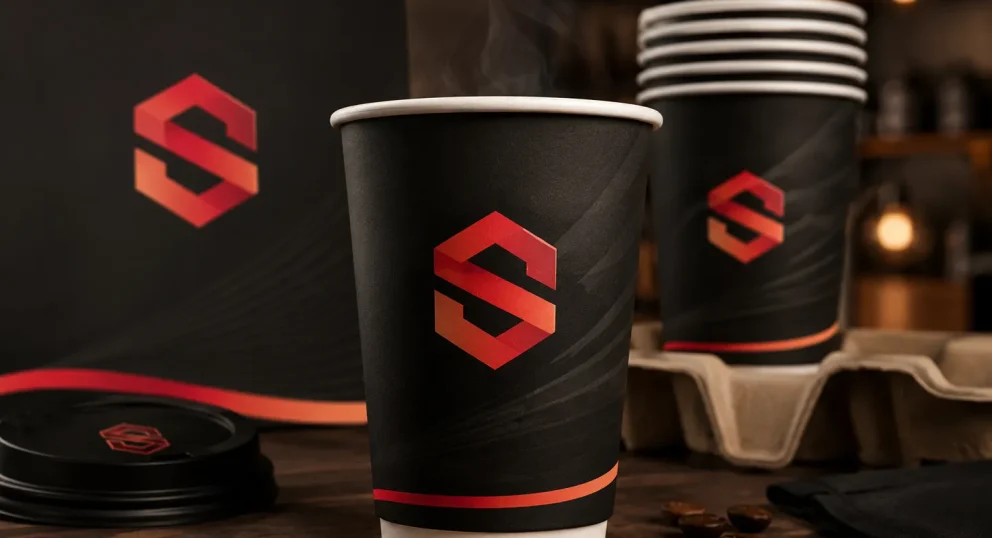

Every time a customer holds their morning coffee, a juice at an event, or a hot drink in a meeting, they are holding your brand in their hands for several uninterrupted minutes.
No digital ad holds attention that long. No banner gets that kind of sustained exposure. A printed paper cup carrying your logo and brand colors stays with the customer from the first sip to the last, and sometimes ends up photographed and shared on social media.
Printed paper cups are not just a printing service. They are a marketing tool that works in your favor every single time the cup is used. The difference between a professionally printed cup and an ordinary one is the difference between a brand that gets remembered and one that gets forgotten.
At Dar Medhat El-Sweidy for Printing, since 1998 we have produced millions of printed paper cups for restaurant chains, cafes, and companies across Egypt, Saudi Arabia, and the Middle East, with consistent print quality, certified food-grade materials, and on-time delivery.
In this guide you will find everything you need before placing any order: cup types, printing technologies, materials and weights, finishes, technical specifications, pricing factors, and common mistakes to avoid.
Why Printed Paper Cups Are a Serious Marketing Tool
Many restaurant and cafe owners think of paper cups simply as a way to serve drinks. In reality, they are an effective marketing tool that reinforces brand presence with every use.
Minutes of Direct Brand Exposure
The average cup is used for 10 to 15 minutes. During that time, your logo, brand colors, and contact information are consistently in front of the customer’s eyes. No other advertising format gives you that level of direct, sustained exposure at the same cost.
A Cup as a Moving Billboard
Every cup that leaves your restaurant or cafe carries your brand into new places. Consumer behavior research indicates that 7 out of 10 consumers are influenced in their purchasing decisions by packaging quality.
Your printed cup is seen not only by the customer who bought the drink, but by everyone around them on the street or in a meeting room.
If a cafe sells 300 cups a day, that translates to 9,000 brand impressions per month at a cost that no other marketing channel can match. It is a marketing investment with a guaranteed return.
This is why many global brands treat printed cups as a core element of their visual identity and customer experience.
Social Media Sharing and Brand Experience
A customer’s experience is the sum of every touchpoint with your brand. A plain white cup says “we sell drinks.” A carefully designed cup says “we deliver an experience.” It adds a layer of professionalism and quality that makes customers feel valued.
A cup with a beautiful design and professional printing gets photographed and shared. That is free content created by customers who are already paying you, not the other way around.
In the age of Instagram, a well-designed cup can reach thousands of people without spending a single dollar on advertising.
Competitive Differentiation
In a market crowded with cafes and restaurants, a cup with a strong visual identity sets you apart immediately. A customer holding your cup in the street is a moving advertisement that never stops.
Investing in professionally printed paper cups pays back double, as marketing funded by the customer who already bought your product.
Types of Paper Cups Available for Printing
1. Single Wall Paper Cup
The most common and most cost-efficient option. A single paper wall with an inner polyethylene coating to prevent liquid seepage.
Suitable for: Cold drinks, moderately hot beverages, events and conferences, and high-volume distribution.
Main limitation: Too hot to hold for extended periods without a sleeve.
2. Double Wall Paper Cup
Double wall cups consist of two layers of paper with an air gap between them that acts as a natural thermal insulator. This helps maintain drink temperature longer, reduces heat transfer to the customer’s hand, and provides a more comfortable experience for hot beverages.
This makes it the preferred choice for specialty coffee shops and cafes.
Marketing advantage: A wider print surface on the outer wall and a higher-quality overall appearance.
3. Eco-Friendly Cups: FSC and PLA
With growing interest in sustainability, demand for environmentally friendly paper cups continues to rise. Available options include:
- FSC-certified paper from sustainably managed sources
- PLA plant-based biodegradable liners
- Materials that help reduce the product’s environmental footprint
Choosing these options not only reflects the company’s environmental commitment but also strengthens brand image among customers who prefer sustainable products.
4. Ripple Cup
A fluted outer sleeve acts as a thermal insulator and adds a distinctive texture, along with a more premium and refined appearance. No additional sleeve needed.
This design gives the cup a comfortable grip during use, better thermal insulation, and a more visually appealing look.
Suitable for: Premium hot beverages and cafes seeking a distinctive visual and tactile experience.
5. Cold Cup
Designed to withstand external moisture from iced drinks. It does not sweat or lose its shape.
Suitable for: Iced drinks, fruit juices, smoothies, and any cold beverage.
A practical note: do not choose based on price alone. A cheaper cup might require add-ons like paper sleeves or special lids, while a higher-quality cup can deliver a better customer experience and greater long-term brand value.
Available Sizes for Printed Paper Cups
| Size | Capacity | Best For |
| Small | 4 to 6 oz (120 to 180 ml) | Espresso, Arabic coffee |
| Medium | 8 to 10 oz (240 to 300 ml) | Coffee, tea, general beverages |
| Large | 12 to 16 oz (360 to 480 ml) | Latte, cappuccino, juice |
| Extra Large | 20 to 24 oz (600 to 720 ml) | Smoothies, cold drinks |
Printing Technologies for Paper Cups
The success of a cup’s design does not depend only on creativity or the strength of the visual identity. It also depends on the printing technology used, since the right method affects color quality, detail accuracy, available quantities, and final production cost.
1. Offset Printing on Pre-Cut Paper, Then Forming
The design is printed on the cup material before it is formed into the cup shape, delivering photographic image quality, vibrant colors, and smooth color gradients. This produces the highest possible print quality for paper cups.
Key advantages:
- Lower cost per unit at large volumes
- High production speed
- Excellent color consistency
- Uniform quality across all cups
Best suited for quantities of 5,000 cups and above, and ideal for cafe chains, large restaurants, and companies that print on a regular basis.
2. Digital Printing on Paper Cups
With advances in digital printing technology, it is now possible to print directly onto cups in smaller quantities with greater flexibility.
Key advantages:
- Suitable for small and medium quantities
- Faster turnaround
- Easy design changes between orders
- No costly setup required for limited runs
Best suited for quantities from 500 to 5,000 cups.
3. Flexographic Printing (Flexo)
The fastest and most cost-efficient option for very large volumes. Best suited for simple designs and solid colors.
Best suited for quantities above 50,000 cups, serving factories and large chains that need high-volume production at the lowest cost per unit.
Not sure which technology suits your quantity? The Dar El-Sweidy team will guide you for free. Contact us now.
Available Finishes for Printed Paper Cups
1. Matte Lamination
A transparent non-glossy layer over the print. It has a smooth, calm feel that communicates luxury and professionalism, and protects the print from scratches and external moisture.
Best suited for: Upscale cafes, fine dining restaurants, and any brand seeking a refined impression.
2. Gloss Lamination
Reflects light and makes colors appear more vibrant and vivid. Ideal for bold designs with strong colors.
Best suited for: Beverage and juice brands, contemporary cafes, and color-rich designs.
3. Soft Touch
An exceptional velvety texture that customers feel the moment they pick up the cup. It adds a sensory dimension that enhances the overall brand experience.
Best suited for: Premium product lines, upscale cafe chains, and special events.
4. Spot UV on the Logo
A localized gloss effect applied to the logo or a specific design element. The visual contrast immediately draws the eye to the brand identity.
Food Safety Requirements for Printed Paper Cups
This is a critical point that few people discuss openly, yet it is what separates a professional printer from an ordinary one.
Low-Migration Inks
These inks are formulated so that their components do not migrate through the paper and into the drink. They are essential for any cup that comes into contact with liquids.
A printer using inks that are not food-grade certified exposes you to health and legal risks.
Inner Polyethylene (PE) Coating
The inner layer of the cup must be made from food-grade approved PE that prevents liquid seepage and protects the drink from interacting with the paper.
Food Compliance Certificates
For markets that require compliance documentation, particularly the Saudi, Gulf, and European export markets, food safety certificates for all materials used are available with every production batch at Dar Medhat El-Sweidy.
Before placing any paper cup order, always ask the printer directly: are your printing inks food-grade certified?
Technical Specifications for Paper Cup Design Files
The Engineering Template (Dieline)
A cup is made from a piece of paper cut in a circular sector shape, not a rectangle. Your design must be placed on this exact template, not on a standard rectangular canvas.
The first step is always to request the correct dieline from the printer before you start designing. A design placed on the wrong template will result in colors or text that are cut off or distorted in the final product.
Resolution and Dimensions
- Minimum 300 DPI: Logos and text must be sharp at print size
- Bleed: 3 to 5 mm around the template edges to avoid white borders after cutting
- Safe Zone: Keep all text and important design elements at least 5 mm from the template edges
Color System and Registration
- CMYK, not RGB: Screen colors differ from printed colors, so convert to CMYK from the start
- Pantone colors for the logo: To guarantee consistent logo color across all production batches, which is especially important for larger chains
- Color Registration: Color alignment in cup printing is highly precise, and all CMYK colors must be accurately registered
Accepted File Formats
- High-resolution PDF: The safest and most reliable format
- AI (Adobe Illustrator): For vector-based logos and designs
- Fonts: Convert all text to outlines before submitting the file
Pre-Submission Checklist
| Requirement | Standard |
| Engineering Template | Correct dieline from the printer |
| Image Resolution | Minimum 300 DPI |
| Color System | CMYK |
| Bleed Margin | 3 to 5 mm |
| Safe Zone | 5 mm |
| File Format | PDF or AI |
| Fonts | Converted to outlines |
| Critical Colors | Pantone code specified |
Common Mistakes in Paper Cup Printing
- Designing on a standard rectangle.
The cup is formed from a circular sector shape. Designing on a rectangle results in colors or text that are cut off or distorted in the final product.
- Ignoring food safety requirements.
Non-food-grade inks or unsafe PE coating expose you to health and legal problems that cannot be fixed after distribution.
- Ordering large quantities without a sample first.
Print a sample, review it, approve it, then confirm the full quantity. An error across 100,000 cups is an expensive mistake.
- Submitting a low-resolution logo.
A logo downloaded from a website at 72 DPI will appear blurry on the cup. Always use the original AI file or a high-resolution PDF.
- Choosing the wrong paper weight.
A 170-gram paper for a large hot coffee cup will bend and deform. Match the paper weight to the drink type and cup size.
- Ignoring color consistency with the visual identity.
The cup color must match business cards, menus, and all other brand printed materials. A printer without a color management system will deliver a different shade with every batch.
Paper Cup Printing Prices in 2026: What Affects Your Cost
There are no fixed prices that apply to all orders, but these factors determine your final price:
- Quantity: The larger the quantity, the lower the unit cost. The difference in per-unit cost between 1,000 and 50,000 cups is significant.
- Cup type: Single wall is cheaper than double wall. Kraft and ripple cups are relatively more expensive.
- Cup size: An 8 oz cup costs less in materials and production than a 16 oz cup.
- Printing technology: Offset is more cost-efficient for large volumes. Digital is more suitable for smaller runs.
- Number of colors: In offset printing, each additional color adds cost. In digital, full CMYK is included at the same price.
- Finishes: Matte lamination costs more than no finish. Soft Touch adds a higher cost on top of that.
To get an accurate quote, send us the cup type, size, quantity, number of colors, and finish, and you will receive a price within 24 hours.
How to Order Printed Paper Cups from Dar Medhat El-Sweidy
Step 1: Contact us and tell us the cup type, size, quantity, and required delivery date.
Step 2: We send you the correct dieline template for your cup size.
Step 3: You send us your design placed on the template.
Step 4: We review the file and send a digital proof for your final approval.
Step 5: Once you approve, production begins immediately and the order is delivered on the agreed date.
Why Dar Medhat El-Sweidy Is the Right Partner for Your Project
-
27 years of experience in food packaging printing.
Since 1998, we have served restaurant chains, cafes, and food companies. Our experience with food safety standards and the requirements of different markets means we understand what you need before you explain it.
-
Certified food-grade inks and materials.
All production materials at Dar Medhat El-Sweidy are food-grade approved. Compliance certificates are available with every batch, providing full assurance of product safety and legal compliance.
-
Absolute color consistency across batches.
We use professional color measurement devices and calibrate our machines on a regular schedule. Your logo color in the first batch is the same in the hundredth, whether printing for Egypt or shipping to Saudi Arabia and the Gulf.
-
Export service to Saudi Arabia and the Middle East.
Our specialized logistics team serves the Saudi and Gulf markets every day. The savings our Saudi clients achieve compared to local printers can reach 30 to 45% including shipping costs.
Your cups deserve printing that reflects the level of your brand. Contact Dar Medhat El-Sweidy now for a free, customized price quote.
Frequently Asked Questions
What is the minimum quantity for printed paper cups?
With digital printing, orders start from 500 cups. With offset, orders start from 5,000 cups to be economically justified.
Can different designs be printed in the same order?
With digital printing, yes, multiple designs can be included in the same batch. With offset, each design requires separate setup.
Are the inks used safe for food contact?
At Dar Medhat El-Sweidy, we exclusively use low-migration food-grade certified inks, with compliance certificates available on request.
What is the difference between single wall and double wall cups?
Single wall is cheaper and more suitable for cold beverages. Double wall provides better thermal insulation and is the preferred choice for premium hot drinks.
Do you ship to Saudi Arabia and the Gulf?
Yes, we serve the Saudi and Gulf markets daily with organized shipping and full tracking.
Conclusion
Printed paper cups are not just an operational step in serving beverages. They are a direct investment in the customer experience and brand image.
Achieving these results depends not only on design, but on choosing the right material, the correct size, the appropriate printing technology, and most importantly a printing partner capable of delivering consistent quality and certified food safety in every production batch.
At Dar Medhat El-Sweidy for Printing, since 1998 we have helped our clients produce printed paper cups that combine high quality, professional printing, and food-grade certified materials to deliver a product that reflects the strength of the brand and gives customers a better experience every time.
Whether you run a new cafe, a restaurant chain, or a company looking for printed cups for events and marketing campaigns, our team is ready to help you find the right solution for your project.
📧 Email: sales@elsewedyprint.com
🌐 Website: www.elsewedyprint.com
📍 Factory: Industrial Zone, 10th of Ramadan City, Egypt
Contact us today for a free consultation and a customized price quote, and discover how a single paper cup can leave a bigger impression than many advertising campaigns.