


Most Companies Notice Their Printing Mistakes Too Late
In a meeting with a marketing director at a major company in Jeddah, he was frustrated about a problem that kept repeating itself every time they printed new promotional materials. Their logo’s blue color never appeared at the same shade twice.
Sometimes it shifted toward green in brochures, and other times it looked washed out on business cards.
He said plainly: “We invest millions in building the brand, then inconsistent print materials come along and undermine that impression entirely.”
This isn’t just a technical problem. It’s a problem with choosing the wrong printing partner.
Corporate paper printing is not just printed paper. It is the tangible moment when your logo transforms from pixels on a screen into a real object in your client’s hands. Every piece you present says something about your attention to detail before you’ve said a single word.
At Al Sweidy Printing, operating since 1998, we serve hundreds of companies in Egypt, Saudi Arabia, and the Middle East with paper printing that maintains consistent visual identity, from business cards all the way to large catalogs. Our expertise in color calibration across different print runs is what separates printing that looks professional from printing that builds genuine trust.
In this guide you’ll find why print materials are a strategic tool rather than a cost, the essential print materials every company needs, how to ensure visual identity consistency, criteria for choosing the right printer, and common mistakes to avoid before any print order.
Why Corporate Paper Printing Is a Strategic Necessity, Not a Luxury
In a world where screens overflow with ads, emails, and daily notifications, most digital messages are consumed quickly and forgotten even faster. But paper printing works in a completely different way.
When you hand over a business card with premium material, or deliver a client a professional folder containing your company proposal, you’re not just transferring information.
You’re giving the client a tangible experience that reflects the level of professionalism and attention to detail within your brand.
This is why corporate paper printing remains one of the strongest tools for building trust and making a first impression, particularly in important meetings, exhibitions, and long-term business relationships.
The Tangible Moment That Digital Cannot Create
First impressions form within seconds, and in many cases your company’s printed materials are a core part of that impression.
In an important business meeting, when you hand over your business card or present a client with an elegant folder containing professional content, you’re not just sharing information. You’re creating a tangible first impression that stays in the memory.
An email is forgotten within minutes. A piece of paper stays on the desk.
The Numbers Speak
Neuromarketing studies confirm that brand recall from a printed material is 70% higher compared to digital advertising.
The reason is simply that print materials can be touched and kept, remain in front of the client for a longer period, and occupy real space in their work environment or office.
Visual Consistency Builds Trust. Inconsistency Destroys It.
A business card with a different color from the brochure, and a brochure with a different color from the catalog, all send an implicit message: “This company doesn’t care about details.” And if they don’t care about the details of their own printed materials, how will the client trust them to care about the details of their project?
Expert advice from Al Sweidy: don’t look at paper printing as an additional cost. Think of it as part of your company’s image and the value it projects to clients. Sometimes a better paper quality or a professional finish can completely change the impression your brand leaves at a first meeting.
Investing in print quality isn’t a luxury. It’s a direct step toward building trust and reinforcing brand professionalism in the market.
Ready to build a unified visual identity you can trust? Contact Al Sweidy’s experts for a free consultation.
The Essential Print Materials for Every Company
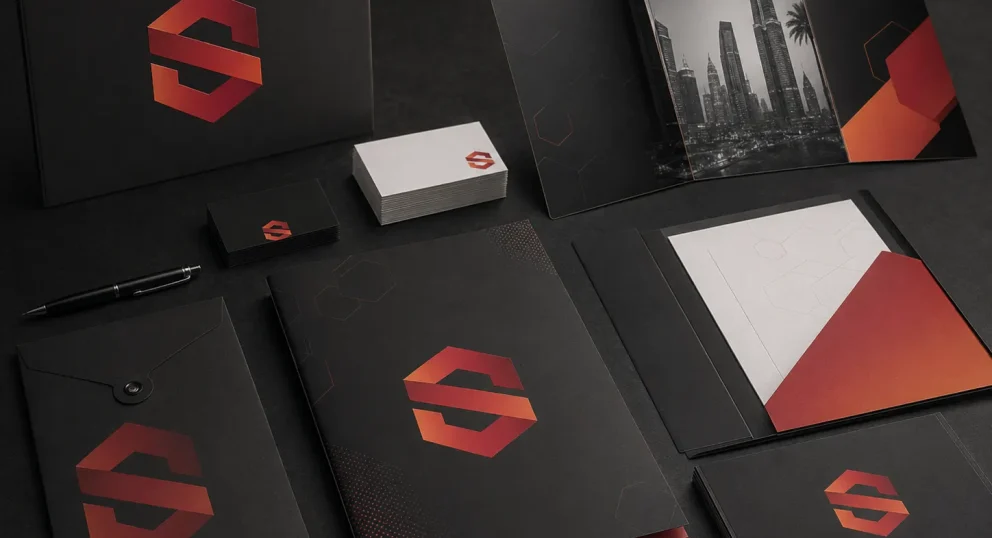
At Al Sweidy Printing, we help companies execute print materials with unified visual identity and color and material quality that reflects brand professionalism in every detail.
1. Business Cards
Your silent ambassador. The smallest print material yet the biggest impression. It stays in a client’s wallet long after meetings end.
Despite the digital shift, business cards remain one of the most powerful professional networking tools, because they are the first tangible piece carrying your company name and contact details in a client’s hand.
But business card quality doesn’t depend only on design. It also relies on paper type, material weight, print precision, and the finishes used.
Available materials:
- Matte coated 350 to 400 gsm: the most popular. Calm and refined, conveying professionalism and stability.
- Glossy coated 350 gsm: vivid colors that highlight bold designs.
- Soft Touch: a velvety texture that makes clients reach to touch the card again, an unforgettable experience.
- Transparent or white PVC: doesn’t bend, doesn’t deteriorate, lasts for years. Ideal for technology and hospitality sectors.
- Kraft paper: a natural and authentic character for eco-friendly and artisan brands.
Available finishes: Spot UV on the logo, hot stamping, gilded edges, Embossing for raised engraving.
2. Letterhead and Official Envelopes
Every official communication, price proposal, letter, and invoice should carry your company’s identity. Professional letterhead reinforces your credibility before the recipient reads a single word.
Specifications: 90 to 120 gsm coated or offset paper. Offset printing for large quantities with absolute color consistency.
Envelopes: printing the logo and address in the same visual identity completes the professional image from the outside before it’s even opened.
3. Brochures and Leaflets
A focused marketing tool that explains a service or product in an engaging way. Distributed at exhibitions, sent with proposals, and placed at company premises.
Available types:
- Bi-fold: 4 pages, ideal for a single service or specific offer.
- Tri-fold: 6 panels, the most common format for a general brochure.
- Z-fold: for fast distribution and exhibitions.
Specifications: 150 to 200 gsm coated paper. Matte lamination for a refined look, glossy for food and consumer products.
4. Corporate Folder
The elegant portfolio you use to present proposals and documents in major meetings. It transforms separate papers into a complete visual experience.
Professional specifications: 350 gsm coated paper with matte lamination. Internal pocket for holding documents. A dedicated slot for the business card.
5. Corporate Catalog
The comprehensive reference that presents all your products with their specifications and images. It stays on a client’s desk for weeks and months, a reference they return to when needed.
Binding types:
- Hidden wire-o binding for full flat opening.
- Saddle stitch for lighter catalogs.
- Hard cover for luxury catalogs targeting the premium segment.
Specifications: internal pages 170 gsm coated, outer cover 350 gsm with lamination.
6. NCR Invoice and Receipt Books
Even procedural documents should carry your identity. Carbon (NCR) booklets printed with your logo and details simplify accounting operations while maintaining a professional appearance in every detail.
7. Marketing Print for Exhibitions and Events
- Roll-ups and banners: attract attention at exhibitions from a distance.
- Branded gifts: pens, notebooks, bags with the company logo, continuous marketing after the event ends.
- Invitations and certificates: VDP printing with personalized names for each recipient.
Need a complete visual identity for your company? Al Sweidy’s team designs and executes everything from A to Z. Contact us now.
How to Maintain a Unified Visual Identity Across All Your Company’s Print Materials
One of the fastest ways to make any company look unprofessional is inconsistent visual identity across different print materials. The logo color differs between the business card and the brochure. The fonts aren’t unified.
This is the point that separates a company that looks professional from one that builds genuine trust in a client’s mind.
This is why professional companies ensure that all their print materials, from business cards and catalogs to exhibition roll-ups, carry the same color quality, fonts, and designs every time they print.
Brand Guidelines: The First Step
Before any print order, your company must have a documented brand guidelines manual that defines:
- Official color shades
- Pantone, CMYK, and RGB codes
- Approved fonts
- How to use the logo
- Safe spacing
- How to apply the identity on different backgrounds
Having this manual prevents random variations in design and printing, especially when materials are executed across different batches or across multiple print types.
Color Calibration Across Batches: Why Do Colors Differ?
Colors differ between batches for several reasons: different machine calibrations, inks from different batches, or paper materials with different whiteness levels.
A printer that doesn’t have a professional color control system produces inconsistent results, and this inconsistency damages your visual identity cumulatively.
How Al Sweidy Guarantees Color Consistency
At Al Sweidy Printing, we don’t rely on the naked eye. We use spectrophotometers and calibrate our machines regularly to ensure exact matching of the Pantone codes specified in your brand guidelines.
Whether you print today or six months from now, you’ll receive exactly the same color shade, whether in Egypt or when shipping to clients in Saudi Arabia, the Gulf, and the Middle East.
Expert insight: before printing any large quantity, always request a certified color proof to review colors, materials, and finishes in physical form.
This simple step helps identify any differences before full production begins and guarantees the final result exactly matches your company’s visual identity.
This proof is your contract with the printer on the final color standard. No disputes after that.
Criteria for Choosing a Corporate Printer: 5 Non-Negotiable Standards
Choosing a printing company isn’t just about price or proximity. It’s about this partner’s ability to represent your brand at the exact level you want your client to see. Because any error in colors, materials, or delivery deadlines directly reflects on your company’s image and professionalism in the market.
In a market full of options, there are core criteria that must not be compromised when choosing a corporate printer.
1. Experience Serving the Corporate (B2B) Sector
A corporate printer understands you have an exhibition deadline that cannot be delayed. They understand that printing an export catalog requires language precision and color quality.
They understand that color consistency across batches isn’t a luxury. It’s a requirement.
Ask the printer directly: do you have documented experience with companies in my sector?
2. Color Quality Guarantee: The Critical Question
One of the most common problems companies face is colors differing between batches, or finishes coming out at inconsistent quality.
The printer must have color calibration systems, continuous quality review, proofs and samples before printing, and clearly specified materials and finishes.
A printer that cannot give a clear answer on this point is not the right partner for a serious visual identity.
3. Capacity Across Varied Quantities
Your company sometimes needs 100,000 brochures for large quantities using offset, and sometimes 50 personalized invitations for limited editions using digital. The ideal partner has the capabilities of both technologies so you don’t need to deal with multiple printers.
At Al Sweidy Printing, we have complete offset lines and Egypt’s largest digital printing machine, integrated solutions under one roof for quantities from 50 to millions of copies.
4. Commitment to Delivery Deadlines
In the corporate world, a delay means losing a season, an exhibition, or an opportunity. Ask about the printer’s reputation for meeting deadlines, especially during peak periods.
Deadline commitment is one of the most important criteria for evaluating any printing partner, particularly for projects tied to launch dates or specific events.
5. Technical Consultation Service
A true partner doesn’t just print. They advise you. They review your files and catch errors before printing. They suggest the most suitable material for your budget. They warn you about choices that could harm your brand’s image.
This service is free at Al Sweidy Printing, because we believe our client’s success begins before the machine starts.
How We Serve Companies in Egypt and Saudi Arabia
In Egypt
Our facility in 10th of Ramadan City sits at the heart of Egypt’s most important industrial zone. We serve companies across Greater Cairo and all governorates with organized delivery and defined timelines.
For the Saudi and Gulf Market
We are a printing partner that understands the Saudi taste and the visual identity requirements of the Gulf market. We execute export orders for companies in Riyadh, Jeddah, the Eastern Province, the UAE, and Kuwait, with consistent quality and organized shipping.
Cost savings compared to local Gulf printers: 30 to 45% inclusive of shipping. A real number our clients see in every order.
For Major Institutions and Large Companies
Annual printing contracts guarantee priority in execution, fixed prices throughout the year, and visually consistent print materials in every batch. Hundreds of companies in Egypt and the Gulf have chosen this model to save time and cost.
Common Mistakes in Corporate Print Materials
Low-quality logo files: a logo taken from a website at 72 DPI comes out blurry and distorted when printed. The correct file is AI or high-quality PDF at a minimum of 300 DPI.
Ignoring safety margins: text placed close to design edges gets cut after trimming. The required Safe Zone is at least 5 mm from every side.
Lightweight paper to cut costs: 90 gsm paper for a business card gives an impression of cheapness that damages the company’s image far more than it saves. The right investment is 350 gsm minimum.
RGB instead of CMYK: screen colors are different from print output. The correct file for printing is always CMYK, with Pantone colors for critical shades.
Inconsistency across print materials: a card with a different color from the brochure erodes the visual identity cumulatively. Work with one printer who guarantees color consistency across all your print materials.
Choosing only the cheapest printer: the lowest price at first may cost you a complete reprint or a lost deal due to poor quality. Calculate the full cost, not just the unit price.
Frequently Asked Questions
What print materials does a startup company need at the beginning?
The minimum that builds a professional visual identity: business cards, letterhead, and one brochure for the main service. As the company grows, the folder and catalog are added. Quality takes priority over quantity. One excellent card is better than ten poor ones.
How long does printing a complete company set take?
A complete visual identity set including cards, brochure, folder, and catalog takes 7 to 14 business days depending on quantities and finishes. With advance planning, we guarantee delivery on the agreed date.
Do you offer annual contracts for companies?
Yes. Annual printing contracts guarantee priority in execution, fixed prices throughout the year, and consistent visual identity in every batch. Ideal for companies that print on a regular basis.
Conclusion
Corporate paper printing is not just an operating cost. It is a direct investment in your brand’s image and the impression it leaves with clients.
In a competitive market, companies that care about the quality of their print materials appear more professional, organized, and trustworthy, because clients automatically connect the quality of the printed materials with the quality of the company itself.
At Al Sweidy Printing, we have helped companies for over 27 years execute professional paper printing that maintains visual identity consistency and reflects brand strength in every detail, from business cards all the way to commercial catalogs, exhibition materials, and event print items.
If you’re looking for a printing partner who understands corporate needs and can deliver consistent quality that reflects your brand’s standard, contact the Al Sweidy team for a free consultation and a price quote suited to your company’s needs.
📧 Email: sales@elsewedyprint.com 🌐
Website: www.elsewedyprint.com