


Every time you hand someone your card, they’re making a judgment, before they read your name, their hands are already forming an opinion about your company.
The truth nobody tells you: your client isn’t just looking at your card, they’re reading your attention to detail, and by extension, your attention to their business. That judgment happens in under a second, and you don’t get a second chance to change it.
Professional business card printing isn’t a line item in your marketing budget, it’s a direct investment in the first impression that stays with your client long after you’ve left the room.
Dar Medhat El Sewedy Printing is a specialist manufacturing facility with over 27 years of experience producing millions of professional cards for leading companies across the Middle East.
Using the latest offset and digital printing technologies, with materials ranging from coated stock and PVC to kraft, foil, and metallic finishes, with direct delivery to your door across all major cities in Saudi Arabia.
In this guide you’ll find everything you need: card types and materials, available finishes, design tips, common mistakes, how to place an order, and delivery timelines. Clear, no filler.
Why Business Cards Still Matter in 2026
With digital networking tools everywhere, it’s a fair question: does a physical business card still have a place in 2026?
The short answer: yes, more than ever.
Your phone runs out of battery. LinkedIn needs an internet connection. Contact-sharing apps require both parties to have them installed. A business card needs nothing. It’s handed over in a second and stays in your client’s possession indefinitely.
Digital alternatives are fast, but they’re forgotten just as quickly. A WhatsApp message disappears into dozens of others. A LinkedIn profile gets viewed once and rarely revisited. A business card sits on a desk, lives in a wallet, and gets seen every day, reminding people of you when you’re not in the room.
The difference between a card that gets kept and one that gets thrown away isn’t the information on it, it’s the full sensory experience.
The card that gets thrown away: thin paper that bends at the first squeeze, faded colours that don’t reflect the original design, nothing to distinguish it from the twenty other cards in the same pocket.
The card that gets kept: substantial paper with weight you feel immediately, a distinctive texture that makes you want to touch it again, a finish that makes it stand out from everything else. That card doesn’t get thrown away, it feels too good to discard.
Al Sewedy tip: A card with premium material and a distinctive finish is your silent salesperson, working for you on your client’s desk every single day.
Available Materials for Business Card Printing
The material isn’t just paper, it’s the first message your client receives before reading your name. Every material says something different about your business, and choosing the wrong one costs you more than the price difference.
1. Premium Coated Stock (Coated Paper)
The foundation most professional cards are built on. At Dar Medhat El Sewedy, we use coated stock starting from 350gsm up to 450gsm, a thickness that resists bending and immediately communicates quality.
Available in three finishes: gloss (vibrant, punchy colours), matte (quiet and refined), and Soft Touch (a velvety texture that resembles natural leather).
Al Sewedy tip: Matte with Spot UV on the logo alone is the most sophisticated combination, restraint everywhere, brilliance exactly where it needs to be.
Best for: All industries. The right starting point for any brand.
2. Soft Touch Cards
A specialist coating applied over the coated stock that transforms it into an unforgettable sensory experience. The velvety texture makes clients handle the card more than once, and every time they touch it, they think of you.
Al Sewedy tip: Soft Touch delivers a perceived value increase that’s completely disproportionate to its cost. If you only have a budget for one upgrade, make it this one.
Best for: Consultants, lawyers, executives, and any profession where the impression of calm sophistication matters.
3. Hot Foil Stamping
A metallic layer, gold, silver, or custom colours, pressed onto specific design elements like your name or logo using heat and pressure. The result is a genuine metallic shine that no standard printing process can replicate. Sharp edges, fine detail, and an immediate visual impact.
Best for: Perfume brands, financial consultancies, law firms, and any brand targeting a premium audience.
4. Gold Edge (Edge Gilding)
Gold applied to all four edges of the card, a small detail with outsized impact. Clients notice it the moment they hold the card. It turns a standard card into a piece of craftsmanship.
Best for: Luxury hotels, jewellery brands, and any identity that wants an immediate “wow” effect.
5. Embossing & Debossing
A three-dimensional raised or recessed effect applied to parts of the design. The logo or name either rises from the card’s surface or sinks into it, a tactile experience that’s memorable even in the dark.
- Embossing (raised): bolder and more prominent, projects confidence.
- Debossing (recessed): more understated and elegant, conveys depth and solidity.
Best for: Luxury brands, designers, and anyone who wants a card that’s felt as much as it’s seen.
6. PVC & Transparent Cards
These cards don’t bend, don’t deteriorate, and aren’t affected by moisture, they look the same years later as they did on day one. Available in white, fully transparent, or partially transparent.
A transparent card creates a visual effect that no other material can achieve, the design appears to float in mid-air.
Best for: Technology companies, executives, hospitality brands, and any identity that wants to say “we’re different.”
7. Kraft & Natural Stock
A warm brown natural material that communicates environmental consciousness and authenticity before a single word is read. Its rough, warm texture creates an immediate sense of credibility and craft.
Best for: Organic and natural products, specialty coffee, eco-conscious brands, and artisan businesses.
8. Custom Die-Cut Shapes
A card cut into a non-standard shape, circular, triangular, shaped like your product, or any creative geometric form. An unusual shape is the first thing the eye is drawn to in a stack of cards.
Best for: Designers, artists, and creative brands that want a card worth keeping as an object in its own right.
9. Double-Sided Printing
Full printing on both sides with two different or complementary designs. It doubles your content space and creates a richer visual experience.
Best for: Anyone who needs to present multiple services, or who wants one side in Arabic and one in English.
10. Smart NFC Cards
The genuine 2026 technology, a card with an integrated NFC chip. Your client holds their phone near the card and your contact details, website, or professional profile open instantly. No camera, no QR code, no app required. Just one tap.
Best for: Technology companies, business people who attend international conferences, and anyone who wants to be at the frontier of innovation.
Materials & Finishes Comparison Table
| Material / Finish | Feel | Durability | Prestige Level | Best For |
| Gloss Coated | Smooth, vibrant | Good | ⭐⭐⭐ | All industries |
| Matte Coated | Quiet, refined | Good | ⭐⭐⭐ | Corporate & services |
| Soft Touch | Unforgettable velvet | Good | ⭐⭐⭐⭐ | Premium professions |
| Hot Foil | Exceptional metallic | Excellent | ⭐⭐⭐⭐⭐ | Luxury & premium |
| Gold Edge | Artistic, distinctive | Excellent | ⭐⭐⭐⭐⭐ | Hotels & jewellery |
| Embossing | Three-dimensional | Excellent | ⭐⭐⭐⭐ | Luxury brands |
| Transparent PVC | Modern, futuristic | Excellent | ⭐⭐⭐⭐ | Tech & hospitality |
| Kraft | Warm, authentic | Moderate | ⭐⭐⭐ | Eco & artisan |
| Die-Cut | Creative, different | Good | ⭐⭐⭐⭐ | Creatives & artists |
| Double-Sided | Rich, complete | Good | ⭐⭐⭐ | Multi-market brands |
| Smart NFC | Technical, innovative | Excellent | ⭐⭐⭐⭐⭐ | Tech & conferences |
Al Sewedy tip: There’s no objectively “best” material, only the most appropriate one for you specifically. A lawyer doesn’t choose the same card as a graphic designer, and an oil company doesn’t need the same finish as a specialty coffee shop. Ask yourself one question: how do you want your client to feel when they hold your card? The answer leads you straight to the right choice.
Available Business Card Finishes
The finish is what separates a card that gets noticed from one that gets kept. A beautiful design is seen, the right finish is felt. And what’s felt isn’t forgotten.
Spot UV vs Flood UV
Both are clear lacquer coatings applied over the print, but the difference between them is significant.
Spot UV is applied only to specific areas of the design, the logo, the name, or any element you want to highlight. It creates a visual and tactile contrast between the matte surface and the glossy spot. Your eye goes directly to where the Spot UV is applied, which is exactly the effect you want.
Flood UV covers the entire card surface with a uniform gloss layer. It protects the print from scratches and moisture and makes colours more vibrant, but it doesn’t create the visual contrast that Spot UV achieves.
Al Sewedy tip: If you only have budget for one finish, choose Spot UV over matte. The contrast between a quiet surface and a targeted shine is the most elegant and impactful combination in business card printing.
Hot Foil vs Cold Foil
Both add a metallic shine, but the results and costs differ.
Hot Foil Stamping is applied using heat and pressure through a metal die. The result is a genuine metallic effect with exceptional brilliance that cannot be replicated by any other method. Sharp edges, fine detail, and an immediate impact.
Cold Foil is applied using adhesive ink without heat. Faster and less expensive, and well-suited for larger areas and high volumes, but its shine lacks the depth of hot foil.
| Criterion | Hot Foil | Cold Foil |
| Shine Quality | Exceptional | Good |
| Detail Precision | Very high | Moderate |
| Best For | Logos & names | Large areas |
| Cost | Higher | Moderate |
| Turnaround | Longer | Faster |
Al Sewedy tip: For premium business cards, always choose hot foil. The visual difference justifies the price difference. Cold foil is better suited to high-volume runs that need wide coverage at a manageable cost.
Embossing vs Debossing
Both add a third dimension to the card, but each communicates something different.
Embossing pushes the logo or name upward from the card surface. Bold and visible, you feel it before you see it. It conveys strength and presence.
Debossing presses the logo downward into the surface. Elegant and understated, a refined tactile experience that communicates depth and permanence.
Both create a tactile memory. The difference is the difference between boldness and elegance.
Al Sewedy tip: Debossing combined with Soft Touch is a pairing that rarely fails. The velvety texture deepens the experience of the recessed impression, making the card feel as though it was made specifically for whoever is holding it.
Edge Painting
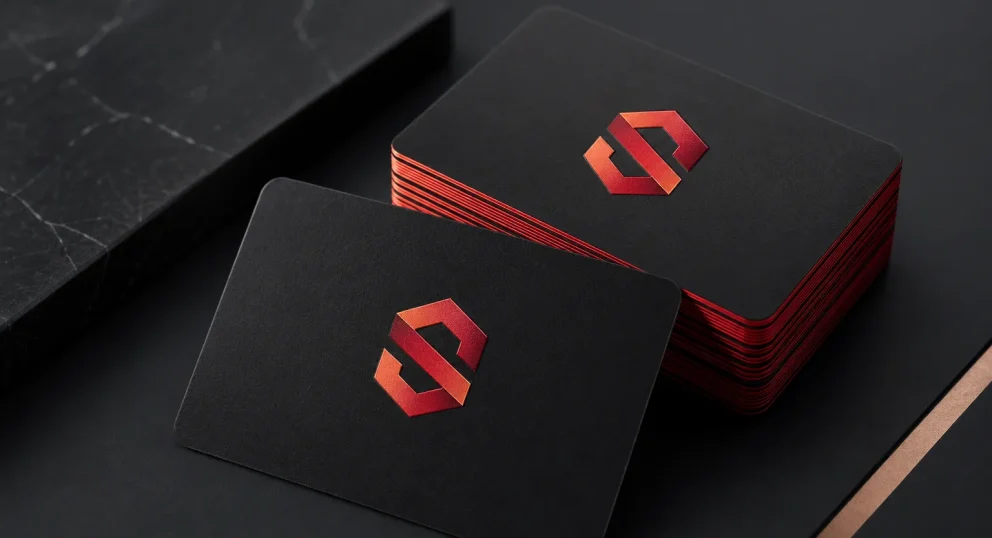
A detail that’s only seen when the card is held, which is precisely its power. Coloured paint applied to all four edges of the card transforms a standard card into a three-dimensional art object.
Available in any colour — gold, silver, red, blue — matched to your brand identity. Pairing it with a secondary brand colour means the card looks considered from every angle.
Best for: Luxury hotels, jewellery brands, premium consultancies, and any card that wants to be an experience rather than just information.
Al Sewedy tip: Edge Painting with matte finish and Embossing is a combination that’s almost impossible to discard. The card ends up on the desk as a design object rather than a contact detail.
Common Mistakes When Printing Business Cards
From 27 years in the printing industry, these mistakes come up repeatedly, and every single one is avoidable with the right decision at the start.
Mistake 1: Sending Low-Resolution Files
An image that looks sharp on your screen can come out blurry and unclear when printed. Screens work at 72 DPI; professional printing requires a minimum of 300 DPI.
The logo downloaded from your website, the screenshot you sent across, the image you compressed to reduce file size, these are all common sources of this problem.
The fix: Ask your designer for the original logo file in AI, PDF, or EPS format. These formats retain their quality at any print size.
Al Sewedy tip: At Dar Medhat El Sewedy we review every file before printing and flag quality issues before they reach the press, because discovering a problem after printing costs everyone time and money.
Mistake 2: Designing in RGB Instead of CMYK
RGB is the colour system for screens, it works with light and produces colours that ink on paper cannot reproduce. CMYK is the colour system for print, and it’s the only one that ensures what you see on screen is close to what comes off the press.
A design that looks vivid on your monitor may print darker and less vibrant when built in RGB.
The fix: Before sending your file, confirm the design has been converted to CMYK inside the design application, not after the file has been exported.
Mistake 3: Ignoring Safety Margins
Every printed piece goes through a cutting process after printing, and cutting isn’t always accurate to the millimetre. If text or important elements are placed too close to the edges, they may be trimmed off in the final product.
Three zones to know:
- Bleed (3mm beyond the card edge): Extend your background colour or image here to avoid white edges after cutting.
- Safe Zone (3mm inside the card edge): Keep all important text and elements inside this boundary.
- Trim Line: The actual edge of the card after cutting.
The fix: Make sure your file includes these zones before sending, or let us know and we’ll walk you through it.
Mistake 4: Putting Too Much Information on the Card
A card packed with text, numbers, and links doesn’t get read, it gets discarded. The human brain instinctively avoids anything that looks complicated at first glance.
A business card isn’t a CV. It’s an introduction. The essentials only: name, job title, phone number, email address, and website or QR code. Everything beyond that creates noise without adding value.
The fix: If you have a lot to communicate, consider a folded card that gives you double the space, or a QR code that connects your client to all your details in one tap.
Al Sewedy tip: Less is always more. The simpler card is the more professional one in almost every case.
Mistake 5: Choosing a Material That Doesn’t Suit Your Industry
A kraft card for an engineer at an oil company. A thin paper card for a managing director at a financial consultancy. Both send the wrong signal, even if the design is beautiful.
The material speaks for your sector and your professional identity before you say a word. Choosing the wrong one creates an unintended contradiction between what you want to communicate and what your client actually feels.
The fix: Ask yourself, what impression does my industry typically convey? Then choose the material that reflects and elevates that impression, not one that works against it.
Mistake 6: Not Requesting a Proof Before the Full Run
Printing 1,000 cards and then discovering the colour didn’t match your expectations, the text is too small, or the finish doesn’t look as you imagined, this happens more often than you’d think.
A proof is a small step that protects you from a significant loss. One minute reviewing a sample saves you the cost of a complete reprint.
The fix: Always request a digital proof (Soft Proof) before approving, and for large orders, request a physical printed sample before the full run is produced.
In summary: most business card printing problems happen before the press starts, in the file preparation and material selection stage. Take your time here, and ask for expert advice if you’re unsure. At Dar Medhat El Sewedy, the consultation is always free.
Business Card Printing Prices 2026
Transparency in pricing is the foundation of trust. No hidden numbers, no surprises after the order. Here’s everything that affects the final price, clearly.
The Four Factors That Determine Price
- Quantity: The golden rule of printing, the more you order, the lower the unit cost. The difference in cost per card between 100 and 1,000 cards can reach 60%.
- Material type: Standard coated stock is priced differently from PVC, and kraft differs from metallic finishes. Every material has a different production cost that directly affects the final price.
- Finishes: Each additional finish adds value and adds cost. Spot UV is less expensive than hot foil stamping; hot foil stamping is less expensive than Embossing with Edge Painting.
- Printing method: Digital printing is better suited to small quantities; offset is more cost-effective for larger volumes, and the cost difference grows as quantity increases.
When to Choose Digital Printing
Digital printing is the smarter choice when:
- Your quantity is under 500 cards
- You need multiple designs in the same order
- You need fast turnaround, 24 to 48 hours
- You’re testing a new design before committing to a full production run
When to Choose Offset Printing
Offset is the smarter choice when:
- Your quantity exceeds 1,000 cards
- You need precise colour consistency with Pantone colours
- You want the lowest possible cost per unit
- Your order is recurring and the specifications are fixed
The Smart Calculation
Many people choose the cheapest available material to save on budget, and that’s exactly what costs them more in the long run.
A business card on standard unfinished coated stock gets thrown away at the end of the day. A business card on matte coated stock with Spot UV, for a modest price difference, gets kept for months and reminds people of you every time it’s seen.
How to Order & Delivery
The ordering process should be straightforward, with no complexity and no surprises in the result. Here’s how it works:
Step 1: Send your design and details Send your logo and card information via WhatsApp or email. If you don’t have a ready design, we can prepare a professional design suited to your brand identity.
Step 2: Review and approve the proof We prepare a final Proof showing you exactly how the card will look before printing. Colours are calibrated using CMYK to ensure the closest possible match between the design and the printed result.
Important: Review all details carefully, numbers, email address, physical address. Any error after approval will appear across the entire print run.
Step 3: Production to specification The order is produced using the appropriate technology — digital or offset — based on quantity and finish requirements. Standard production time is 48 to 72 working hours, with slightly longer timelines for specialist finishes such as foil or embossing.
Step 4: Packaging and delivery Cards are packaged to protect them from scratches or damage during transit. We offer fast delivery direct to your office door across:
- Dammam
- Khobar
- Dhahran
- Qatif
From first message to delivery, the goal is a smooth process and a result that matches exactly what you approved.
Frequently Asked Questions
Can a QR code be added to the business card?
Yes, and we strongly recommend it. A QR code links the card to your website or LinkedIn profile, making it easy for contacts to save your details and reach you directly.
What’s the best weight for a business card?
The minimum we’d recommend is 300–350gsm. For premium cards, 350–450gsm with a finish like Soft Touch or Spot UV is the preferred choice.
What’s the best finish for a business card?
It depends on your goal:
- Soft Touch: luxurious, tactile feel
- Spot UV: highlights the logo
- Foil (gold/silver): premium visual impact
- Emboss: distinctive three-dimensional effect
Does the card deteriorate over time?
It depends on the material:
- Standard paper: may show wear with regular handling
- With lamination: lasts considerably longer
- PVC: lasts years with no deterioration
Can both sides be printed?
Yes, and we recommend it, it makes far better use of the available space. The reverse side is ideal for services, a QR code, or social media handles.
What’s the standard business card size?
The most widely used size is 9 × 5 cm. Custom sizes are available for any design requirement.
Why Choose Dar Medhat El Sewedy?
A business card isn’t just a contact tool, it sells you when you’re not in the room. It’s the first thing held, and the last thing kept.
The question isn’t “should I print a card?” It’s “what impression do I want to leave?”
The difference between a card that gets thrown away and one that gets kept isn’t the name or phone number on it. It’s the quality, the material, the feel, and the decision made before printing.
At Dar Medhat El Sewedy, we don’t just print cards. We help you choose:
- The right material for your business
- The finish that reflects your identity
- The technology that gives you the best result for your budget
With over 27 years of experience and millions of cards produced across multiple industries, we know exactly what makes a card get noticed, and get kept.
What you get with us:
- Consistent print quality, right the first time
- Technical review of your file before production begins
- Recommendations built on experience, not on upselling
- Delivery commitments with no surprises
The result? A card that represents not just your contact details, but your actual value.
If you want a business card that reflects your business at the level it deserves and leaves an impression that lasts, the next step is simple:
Get started now, send your design or your details, and we’ll help you choose the right material and finish, and produce a professional card that gets it right the first time.