

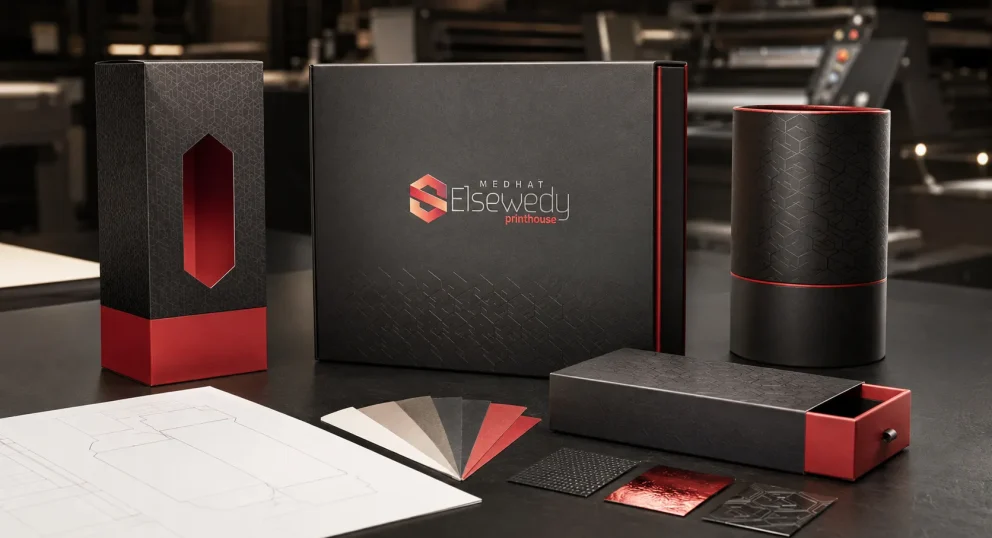

Professional packaging printing does not start with choosing a beautiful box shape. It starts with understanding the product the packaging will hold, how it will be displayed, who will buy it, and the impression your brand wants to leave from the very first moment.
Packaging performs more than one function at the same time. It protects the product, presents its identity, communicates the required information, and helps it stand out among competitors.
Getting the material, size or finishing wrong can raise the cost without adding real value to the product.
Since 1998, Dar Medhat ElSewedy Printing has worked with companies, factories and brands to deliver printing and packaging solutions across different sectors, starting from design and dieline review and material selection, through printing and finishing, up to preparing commercial quantities.
But what type of packaging suits your product? What material do you need? Should you choose a folding carton or rigid box? And when do finishes like hot stamping or spot UV justify their cost?
In this guide, you will find practical answers to help you choose the packaging type, material, printing method and finishing, and understand the cost factors before production begins, so you get packaging that serves your product, your budget and your brand together.
Why Has Packaging Become a Marketing Tool, Not Just Protection?
Three Seconds, That Is All You Have
In a retail environment, the purchase decision happens in under three seconds. The consumer scans the shelf and stops at what catches their eye, not necessarily at what is best.
Protection is packaging’s first function. But visual appeal and the tactile experience are what actually sell.
The Unboxing Phenomenon: Free Marketing Your Packaging Creates
Hundreds of millions of views on YouTube and Instagram go to unboxing videos. This is not a coincidence. It shows that customers now value the opening experience as much as the product itself.
Carefully designed packaging creates a moment of anticipation and excitement. That moment gets filmed and shared, giving your brand free marketing you did not pay a cent for.
Perceived Value: Why the Same Products Sell at Different Prices
The same chocolate, the same weight, the same ingredients. One in a plain wrapper, and another in a rigid box with gold hot stamping. The second sells for three times the price, and the customer accepts it.
Because perceived value is decided before the product is even opened.
ElSewedy Insight: Do not think of packaging cost as an expense. Think of it as an investment in your first physical point of contact with your customer. A 15 percent increase in packaging cost can justify a 40 percent increase in selling price.
Types of Printed Packaging: Which One Suits Your Product?
Choosing the packaging type comes before the material and the finishing, because the shape of the packaging determines how it opens, how well it protects the product, its manufacturing cost, and even the customer’s experience with it.
Here are the most common types to choose between.
1. Folding Carton
The most common and widely used type. It is printed on cardboard, cut, and folded to form the box. It ships and stores flat, which saves huge space in storage and shipping.
Advantages: reasonable production cost for large quantities, high design flexibility, and suitability for most market sectors.
Best suited for: pharmaceuticals, cosmetics, packaged food, small electronics, and any product displayed on retail shelves.
2. Rigid Box
Does not fold, and is made from solid chipboard 1 to 3 millimeters thick, wrapped in premium printed paper or fabric. When you hold it, you feel its weight and firmness, and that feeling says “premium” before you even look at what is inside.
Advantages: an immediate impression of quality and luxury, room for elegant finishing, and it often gets kept after the product is taken out, becoming part of the decor.
Best suited for: perfumes, watches, premium chocolate, high end electronics, occasion gifts, and any product targeting the upper market segment.
3. Drawer Box
A box made of two parts, a base and a sliding sleeve. The product is revealed gradually as the drawer is pulled out, creating a unique opening experience and a real “wow” moment.
Advantages: a distinctive and interactive opening experience, a sense of surprise and anticipation, and it is ideal for products that want a dramatic reveal.
Best suited for: jewelry, perfumes, special gifts, limited editions, premium chocolate, and any product that wants to be an experience, not just a product.
4. Sleeve Box
An inner box wrapped in an outer sleeve that slides off to reveal it. The outer sleeve can carry a different design from the inner box, giving great creative flexibility.
Advantages: an extra layer of appeal, two visual identities on the same product, and it is relatively economical compared to a rigid box.
Best suited for: seasonal products such as Ramadan or New Year gifts, cosmetics, multi-piece gift boxes, and any product that wants to add a layer of intrigue.
5. Printed Paper Bags
An ambassador for your brand on the street. Everyone carrying the bag becomes a moving advertisement for your brand. With growing environmental awareness, paper bags reflect a brand’s sense of responsibility.
Available types:
- Flat paper handle bag: economical and suitable for large quantities.
- Rope handle bag: a higher level of luxury, suitable for upscale stores and shopping centers.
- Kraft bag: a natural and eco-friendly character, ideal for organic products and specialty stores.
Best suited for: retail stores, restaurants and cafes, events and exhibitions, and occasion gifts.
6. Food Boxes and Restaurant Packaging
Food safety comes first, then visual appeal. Paper cups, meal boxes, sandwich bags, all of these must be made from food grade approved materials.
Mandatory specifications: food grade approved paper that does not react with food, an internal PE coating to prevent grease and liquid leaks, food safe inks that do not transfer to the product, and resistance to suitable temperatures.
Best suited for: restaurant chains, cafes, delivery restaurants, food factories, and any business handling food for direct consumption.
7. Pharmaceutical and Medical Packaging
There is no room for laxity in precision. Every letter, every number, every barcode must be clear and match regulatory standards. Errors in pharmaceutical packaging can mean an entire production batch gets recalled.
Core requirements: inert materials that do not react with pharmaceutical formulations, internationally approved medically safe inks, clear printing of mandatory information in the smallest readable font, absolute color precision to distinguish different products, and compliance certificates with every production batch.
8. Cosmetics and Personal Care Packaging
This sector sells the dream before the product. Packaging is part of the brand’s promise of beauty and elegance.
Exceptional color precision, since even a small color deviation completely changes the impression. Premium finishing that reflects the product’s value. Color consistency across every batch to keep the visual identity coherent.
Packaging Printing Materials: How Do You Choose the Right One?
The wrong material ruins the best design. A material lighter than required means boxes that warp. A material heavier than required means an unjustified cost.
Choosing the packaging material directly affects the shape, sturdiness, print quality, finishing and cost. For this reason, there is no single material that is best for every product.
1. Coated Duplex or Art Card
One of the most used materials in commercial packaging printing, especially when you need a good balance between appearance and cost.
It forms the foundation of most retail packaging. An outer coated white layer gives exceptional print quality, with a grey or brown inner layer.
Choose it when: your priority is practical packaging at a reasonable production cost.
Weights and uses:
| Weight (gsm) | Best Use |
| 250 to 300 gsm | Light products under 250 grams |
| 350 gsm | Medium products up to 500 grams |
| 400 gsm | Heavy products or ones needing higher rigidity |
| Duplex, two layers | Products over one kilogram or requiring maximum rigidity |
2. Ivory or FBB
A smoother and higher quality material in terms of appearance and printing, used widely when the packaging shape is an important part of presenting the product.
Suitable for: cosmetics, perfumes, health products, sweets, and premium products.
Colors and fine details show up well on it, and it also suits many types of finishing.
- Kraft Board
A natural brown color from wood fibers. It suggests authenticity and sustainability. Colored printing on it is less vivid, but the natural character makes up for that and adds a personality no other material has.
Best suited for: organic and natural products, specialty coffee, artisanal sweets, and eco-friendly brands.
- Chipboard
The foundation of rigid boxes and drawer boxes. Thicknesses from 1 to 3 millimeters. Real sturdiness in the hand, its weight and durability are what create an instant impression of luxury.
It is wrapped in premium printed paper, fabric, or synthetic leather as required.
- FSC Certified Paper
For brands that put sustainability at the core of their identity. Certified by the Forest Stewardship Council, and sourced from documented sustainable sources.
A strong message to your customers, that you care about the planet.
Does a More Expensive Material Mean Better Packaging?
No. Using a higher cost material for a product that does not need it can raise the packaging price without the customer feeling a difference that justifies the increase.
On the other hand, choosing a material weaker than the product needs can lead to a warped box, weaker protection, or the product appearing below its actual value.
ElSewedy Insight: Instead of asking what the best material for packaging printing is, the more precise question is what the minimum specification is that achieves the shape, strength and quality your product needs, without extra cost. This is where a press’s experience shows. Choosing the material is not about selling the most expensive paper, but choosing the right material for the product.
Packaging Finishing: The Touch That Makes the Difference
Printing is the beginning. Finishing is what turns packaging from good into unforgettable.
After choosing the packaging type and material, finishing comes next, and this is where a large part of the difference happens between packaging that looks ordinary and packaging that reflects the brand’s level.
But a common mistake is treating finishing as luxury add-ons that should be used as many of as possible.
1. Matte Lamination
A transparent, non-glossy plastic layer that protects the printing and gives it a calm, elegant look. It does not reflect light, and its texture is smooth and pleasant.
Best suited for: premium packaging, high end cosmetics, and brands that want an impression of stability and professionalism.
2. Gloss Lamination
Reflects light and makes colors look more vivid and bright. It has a strong visual effect on food photos and consumer products.
Best suited for: food and beverages, consumer packaging, and bold designs with strong colors.
3. Soft Touch Lamination
The velvety texture that makes anyone holding the packaging want to touch it again. An unforgettable sensory experience that says this product is different.
Best suited for: very premium packaging, perfumes, watches, and any product that wants an exceptional tactile experience.
ElSewedy Insight: Soft touch with spot UV on the logo is the strongest combination in premium packaging. A velvety matte background with a glossy touch on the logo creates a visual and sensory contrast that is hard to resist.
4. Spot UV
A glossy varnish layer applied to specific areas only, such as the logo, product name, or an image. It creates a visual and sensory contrast that catches the eye immediately.
The ideal combination: matte lamination as the background, plus spot UV on the logo, gives elegance and distinction at the same time.
5. Hot Stamping
A real metallic foil, gold, silver, copper, or any color, applied with heat and pressure. No golden ink can imitate a real metallic shine.
Why does everyone choose hot stamping on the logo? Because a shiny metallic logo on dark packaging screams luxury before it is even read.
Best suited for: logos and brand names on premium packaging, invitations and official print materials, and any element you want to be the first focal point.
6. Embossing and Debossing
Embossing raises the logo or text above the packaging surface, creating a three dimensional bump the hand can feel.
Debossing carves the element inward smoothly, giving a calm and grounded elegance.
Both add a third dimension that an image alone cannot deliver.
A warning: avoid very fine details, since a simpler design gives a stronger effect, and very thin lines may not print correctly.
7. Die Cut
A metal die made to the required shape cuts the packaging in any form, transparent windows to show the product, design openings, or unconventional shapes.
Best suited for: adding a transparent window to a chocolate box, creating a unique opening tab, and any creative, non-rectangular shape that expresses the brand’s personality.
How Do You Choose the Right Finishing?
| Your Goal | The Finish Worth Considering |
| A calm and elegant look | Matte |
| More vivid colors | Gloss |
| A luxurious feel to the touch | Soft touch |
| Highlighting the logo | Spot UV |
| A premium metallic look | Hot foil |
| Adding a textural dimension | Embossing |
| A special shape or window | Die cut |
Should You Combine More Than One Finish?
You can, but more is not always better.
For example, soft touch with spot UV gives an elegant contrast between the matte background and the glossy elements.
Matte with hot foil and embossing can suit a premium product that needs its name or logo highlighted.
But adding four or five finishes to a crowded design can raise the cost and weaken the result instead of improving it.
ElSewedy Insight: Before adding any finish, ask what it will add to the customer’s decision or their feeling about the product. If there is no clear answer, you probably do not need it.
Offset or Digital Printing: Which Is Better for Packaging Printing?
There is no single method that is best for every project. The choice between offset printing and digital printing depends mainly on quantity, material type, the level of colors and finishing required, and the nature of the project itself.
Offset Printing
Offset is the most common choice when producing commercial and large quantities of packaging.
Once the project setup is done, unit cost becomes more efficient as quantity increases, along with good ability to maintain color consistency and specifications throughout production.
It is more suitable when:
You need thousands of pieces. You have repeat production. Brand color consistency matters. The packaging needs multiple finishes. You want to lower unit cost as quantity grows.
Digital Printing
It does not need the same setup as offset, which gives more flexibility in some projects with limited quantities.
It is more suitable when:
You need a small quantity. You are testing a new product. You have a seasonal or limited edition release. You need more than one design in limited quantities. You want a sample or a first batch before moving to larger production.
What About Print Quality?
The question is not simply whether offset is better than digital.
Digital printing technology has developed a great deal, while offset remains strong for commercial production, consistency of results, and large quantities.
For this reason, quality should be evaluated in the context of material, quantity, colors, finishing and the required outcome.
ElSewedy Insight: Do not choose the printing machine first and then try to fit your project around it. Start with the product, the quantity, the material, the quality level and the budget, then choose the production method that serves that equation.
Common Mistakes in Packaging Printing
Mistake one: choosing the wrong cardboard weight.
A 250 gsm box for a product weighing 700 grams will bend and warp. Choose the right weight for the product first, then negotiate on cost.
Mistake two: ignoring the dieline.
Designing on a plain rectangle without a correct dieline produces a box that does not fold properly. Always start with the dieline.
Mistake three: text on fold lines.
A logo or name placed on a fold line gets distorted during assembly. Stay at least 5 millimeters away from any fold line.
Mistake four: images at 72 DPI.
They look great on screen, and blurry and distorted when printed. Always use at least 300 DPI.
Mistake five: RGB instead of CMYK.
Colors look beautiful on screen and turn out completely different when printed. Use CMYK from the very first moment of design.
Mistake six: overdoing the finishing.
Hot stamping plus spot UV plus embossing plus die cut on a crowded design creates visual chaos. Using two finishes wisely is better than four used randomly.
Mistake seven: printing a large quantity without a sample.
Always request a mockup. The cost of a sample is nothing compared to the cost of reproducing 10,000 pieces of packaging.
Mistake eight: neglecting mandatory information.
For food: ingredients, weight, expiry date, country of origin. For pharmaceuticals: dosage, warnings, batch number. Missing these means real regulatory problems.
Packaging Printing Prices in 2026: The Factors That Affect Cost
After determining the packaging type, material, printing method and finishing, we arrive at the question that matters most to project owners.
How much does packaging printing cost?
There is no fixed price that applies to every project. The same box can vary significantly in cost just by changing the material, size, quantity, or adding a single finish.
For this reason, when requesting a price quote, several factors determine the final cost.
1. Quantity
Quantity is one of the most influential factors on unit price.
In many offset projects, as quantity increases, setup, die and preparation costs are spread over a larger number of pieces, which improves the unit cost.
So do not compare a price quote for 1,000 pieces to one for 10,000 pieces based on the total alone. Compare the unit cost as well.
2. Size and Shape of the Packaging
The larger the box, the more material it usually consumes.
But size alone is not enough. How the dieline is arranged on the printing sheet also matters. Sometimes a small adjustment in size leads to better material use and less waste.
3. Material Type and Thickness
Duplex, ivory, kraft and greyboard do not cost the same, and changing the GSM or thickness affects the price.
For this reason, the material should be chosen based on the product’s need, not price alone.
4. Number of Colors and Printing Method
The production method itself affects cost.
Is the project suited to offset or digital? Does it need special colors such as Pantone? Are there precise brand identity requirements? All of these details factor into pricing.
5. Finishing
Every additional process means an additional production stage.
Lamination, spot UV, hot foil, embossing, debossing and die cutting can raise the value of the packaging, but they raise the cost too.
For this reason, do not add a finish unless it genuinely serves the product.
6. Dies and Setup
Some projects need a die cutting form, a foil block, an embossing die, or other setup tools.
This cost may appear larger on the first order, while some setup tools can be reused on later orders if the specifications do not change.
7. Assembly and Gluing
A simple box with one glue line is not the same as a multi-part rigid box or packaging that needs internal assembly.
The more manual or automated assembly steps involved, the more the production cost changes.
Why Don’t We Publish a Fixed Price for Packaging Printing?
Because a statement like “printing 1,000 boxes for price X” tells you almost nothing without knowing the size, material, design, finishing and production method.
The cheaper quote may be based on a completely different material from the higher one.
To get an accurate price, send us the quantity, size, product type, material if known, required finishing, and the design or dieline if available.
And if you do not know the right material or finish, you can start with the product, quantity and target budget, and we will determine the suitable specifications.
How Do You Know Packaging Suits Your Product Before Printing the Full Quantity?
A design may look excellent on screen, but real packaging success shows once it turns into a physical product.
Before approving a large quantity, review these points.
- Is the size actually suitable for the product?
Packaging that is too large increases material consumption and storage and shipping space, while packaging that is too tight can make it hard to insert the product or expose it to damage.
The goal is the smallest suitable space that protects the product and presents it well.
- Can the packaging handle the product’s weight?
The box shape alone is not enough. Test the material, the fold and glue points, and the base of the box, especially if the product is heavy or the packages will be stacked.
- Is it easy to open and close?
Try the packaging the way the customer will use it. Does it need effort to open? Is the product easy to take out? Can it be closed again if the product needs that?
The user experience is part of the packaging design.
- Is the most important information clear?
Put the packaging in front of you and ask the following. Does the brand name show clearly? Is the product type clear? Can the essential information be read easily?
Packaging is not a space to fill with as much text as possible.
- Do the colors and material match?
The color you see on screen may look different once printed on ivory, kraft, or another material.
For this reason, the design, material and printing should be evaluated as one unit.
- Does the finishing highlight the right part?
If you used spot UV, foil or embossing, it should direct the customer’s eye to something important, such as the logo or the product name.
If the finishing becomes the first thing you see while the product itself disappears, the design needs a review.
- Is the packaging suitable for transport and display?
Think about what happens after the packaging leaves the press.
Will it be placed on a shelf? Shipped to the customer? Stored inside a larger carton? Stacked in a warehouse?
Successful packaging has to work through the entire journey, not just during the photo shoot.
Dar Medhat ElSewedy: Your Packaging from Idea to Delivery Under One Roof
Why Us?
27 years of experience: since 1998, we have served brands in Egypt, Saudi Arabia, the Gulf and the Middle East, with experience across every sector, pharmaceuticals, food, cosmetics, chocolate, and electronics.
An integrated facility under one roof: offset and digital printing, full finishing (soft touch, spot UV, hot stamping, embossing, die cut), binding, packaging and shipping. No scattering between separate parties, and consistent quality at every stage.
A specialized design team: no design yet? Our team builds the dieline and designs from scratch. Have a design already? We review it for free and fix any technical issue before printing.
Free file review: our technical team reviews every file before printing, because catching an error before the machine runs saves everyone time and money.
A mockup and physical sample before production: your approval of the sample is a core requirement before full production begins.
Export to Saudi Arabia, the Gulf and the Middle East: organized shipping and full customs clearance for whichever market you target.
ElSewedy Insight: Start communicating with us 3 to 4 weeks before any launch. Planning ahead removes the stress factor and ensures your packaging arrives before the deadline.
Frequently Asked Questions
What is the difference between a rigid box and a folding carton?
A folding carton is printed, cut and folded from cardboard, and is more economical for large quantities. A rigid box is made from solid chipboard that does not fold, giving an immediate impression of luxury and a heavy feel. The difference in use is general consumer goods versus a premium product.
What is the minimum quantity for custom packaging printing?
With digital printing, it starts at 50 to 100 pieces. With offset, it starts at 500 to 1,000 pieces to be economically viable.
Can packaging be designed in an unconventional shape?
Yes, die cut allows any shape you want, a transparent window, a custom opening tab, a non-rectangular shape, any creative idea can be executed with a custom cutting die.
Can more than one finish be combined on the same packaging?
Yes, soft touch plus spot UV plus hot stamping on the same packaging is very common. But the smart approach is in the choice, not the quantity. Every finish should serve a specific visual purpose.
Do you serve the Saudi and Gulf markets?
Yes, we export regularly to Saudi Arabia, Kuwait, the UAE, Oman and the Gulf. Our price quotes are door to door and include shipping.
Conclusion
Professional packaging printing is the strategic decision that separates a product sold at its price from a product sold at a higher price. Packaging is the first conversation between you and your customer, and that conversation happens in seconds.
Successful packaging protects the product, reflects the brand’s value, works well during transport and display, and can be produced in suitable quantities without waste or unnecessary cost.
At Dar Medhat ElSewedy Printing, we treat every project as a complete production system, starting from dieline and file review, material and printing method selection, through finishing, quality control, and preparing the order for delivery or export.
Since 1998, our goal has not only been to print the packaging, but to help you reach production specifications that suit your product, your budget and your brand’s growth plan.
Ready to start printing your product’s packaging? Send us the product type, quantity, size, required finishing, and design file if available, and get a technical review and a custom price quote for your project.
Meta Title: Professional Packaging Printing | Print with ElSewedy
Meta Description: Looking for packaging printing for your product? Explore box types, materials, printing methods, finishes, and cost factors with Medhat ElSewedy Printing.